

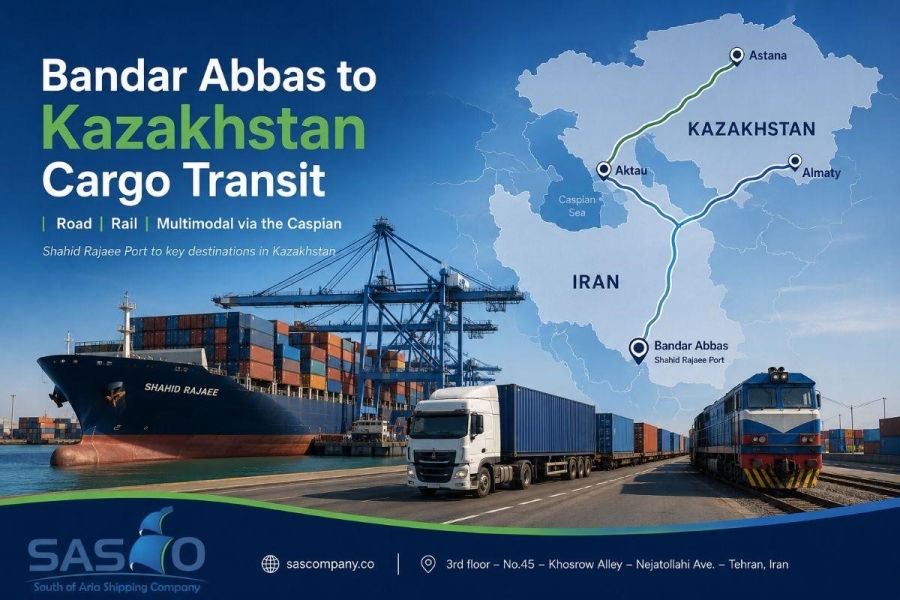
Bandar Abbas to Kazakhstan Transit at a Glance
|
Transport Option |
Typical Routing Structure |
Best Suited To |
Transit Time* |
Pricing Basis |
|
Road Freight |
Bandar Abbas → Iranian road network → Turkmenistan → Kazakhstan, or via Uzbekistan depending on destination |
FTL cargo, machinery, time-sensitive shipments, flexible inland delivery |
5500 USD |
Truck/container rate + border and handling charges |
|
Rail Freight |
Bandar Abbas → Iranian rail network → Sarakhs or Incheh Borun → Central Asia → Kazakhstan |
Heavy cargo, regular container traffic, bulk or higher-volume shipments |
3500 USD |
Wagon/container rate + terminal and border-transfer costs |
|
Multimodal via the Caspian |
Bandar Abbas → road/rail across Iran → Iranian Caspian port → Aktau → onward delivery |
Aktau, Atyrau, Tengiz and other destinations in western Kazakhstan |
1300 |
Combined inland, port, Caspian-sea and onward-transport costs |
*Transit times vary according to the final destination, border and terminal conditions, equipment availability, cargo requirements, and the selected transport structure.
How Does Cargo Move from Bandar Abbas to Kazakhstan?
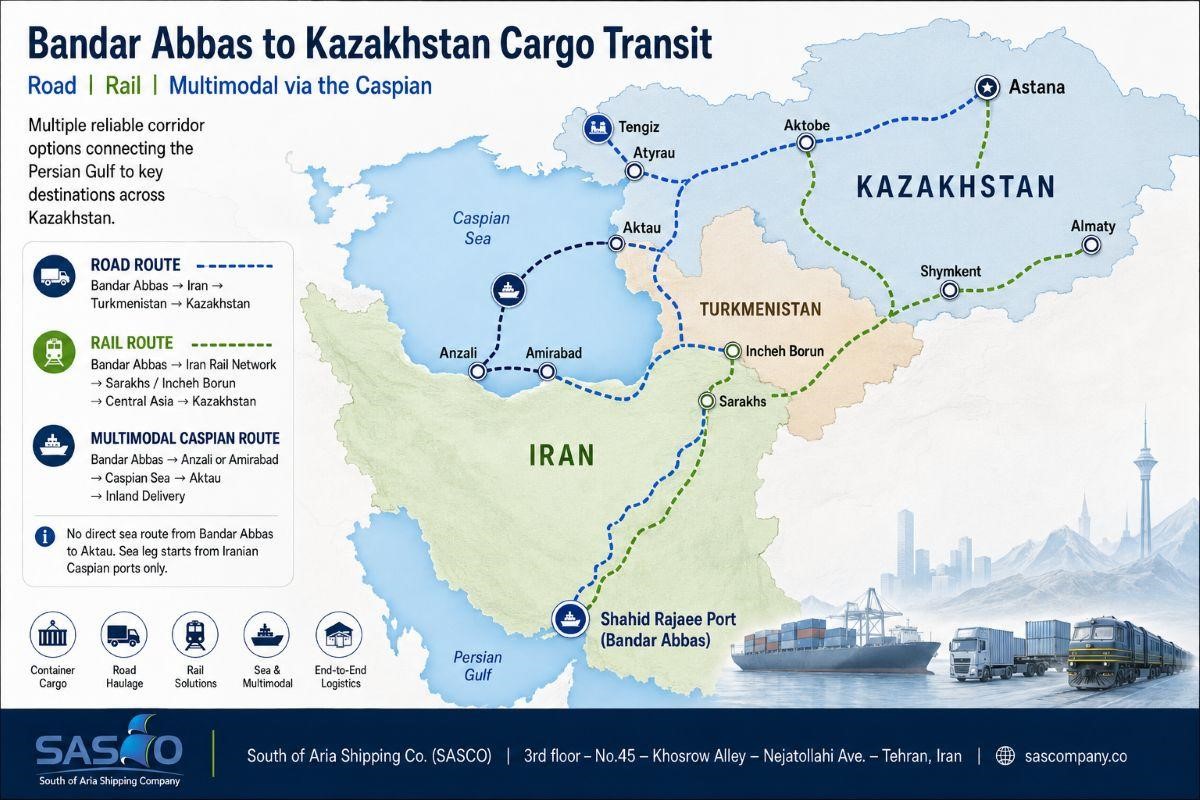
Shahid Rajaee Port in Bandar Abbas is Iran’s main southern gateway for Kazakhstan-bound cargo arriving by sea. Because Kazakhstan is landlocked, cargo discharged at Bandar Abbas must continue by road, rail, or a multimodal route under transit through Iran. Bandar Abbas to Aktau is therefore not a direct sea voyage: the Persian Gulf has no navigable connection with the Caspian Sea. Cargo routed to Aktau by sea must first move by road or rail to an Iranian Caspian port such as Anzali or Amirabad, then cross the Caspian by vessel.
Bandar Abbas to Kazakhstan Transport Routes
The best route for Kazakhstan cargo via Iran depends on the final destination as well as cargo dimensions, equipment availability, border conditions, permits, container ownership, transit time and cost.
1. Road Freight from Bandar Abbas to Kazakhstan
Bandar Abbas to Kazakhstan road freight normally starts with trucking from Shahid Rajaee Port through Iran toward Turkmenistan and onward Kazakhstan; for some eastern destinations, routing through Uzbekistan may also be considered. The exact exit point and onward corridor should be selected shipment by shipment.
SASCO’s road freight transport in Iran is particularly relevant to FTL trucking to Kazakhstan, machinery, project-related loads and cargo requiring flexible inland delivery. Container transit through Iran can also move by truck when rail schedules or wagon availability do not match the required delivery window.
Cross-border trucking requires coordination of transit declarations, vehicle and driver documents, border formalities, abnormal-load permits where required and, where applicable, TIR transport. Its main advantage is route and delivery flexibility without dependence on rail terminal schedules.
For containerized cargo, the transport plan should also determine whether the container can remain with the same transport arrangement through the transit leg or requires a handover at a border or inland terminal.
2. Rail Freight from Bandar Abbas to Kazakhstan
For Bandar Abbas to Kazakhstan rail freight, cargo can enter Iran’s national railway from Bandar Abbas and move northeast toward the Central Asian rail system. Sarakhs and Incheh Borun are key Iranian rail gateways toward Turkmenistan and onward Kazakhstan; their role within the wider Iran rail freight corridors makes border coordination an important part of route planning. SASCO’s rail freight services in Iran support both containerized and heavier cargo moving through these gateways.
Rail becomes attractive where cargo weight, volume or shipment frequency justifies terminal handling. Standard 20ft and 40ft containers can move on container wagons, while bulk commodities and heavy industrial cargo require suitable wagon types. Wagon availability should be confirmed before dispatch because allocation depends on equipment type, commodity and cross-border supply.
Iran uses standard-gauge track while the wider CIS network uses 1,520 mm gauge, so the operating plan must account for gauge transition at the Iran–Turkmenistan interface. Depending on the service and equipment arrangement, this may involve container transshipment, wagon or bogie exchange and additional terminal handling. SOC containers can be useful because they reduce dependence on carrier-owned container return arrangements across multiple rail systems.
3. Multimodal Route via the Caspian Sea to Aktau
For western Kazakhstan, an alternative structure is Bandar Abbas → road/rail across Iran → Anzali or Amirabad → Caspian vessel → Aktau → final inland delivery. This route can suit Aktau, Atyrau, Tengiz and other western destinations, especially for project cargo, OOG cargo and heavy equipment requiring route-specific handling. Caspian vessel schedules, port handling capacity and the final inland leg from Aktau should be assessed before the route is fixed.
The corridor is also supported by practical SASCO experience. In a Kazakhstan-bound multimodal project, containers were moved across Iran to Anzali, shipped to Aktau and delivered onward to Tengiz. The operation took 40 days end-to-end, but that figure should not be used as a Bandar Abbas–Kazakhstan transit-time benchmark: the shipment originated in Jebel Ali and entered Iran through Imam Khomeini Port.
Bandar Abbas to Kazakhstan Transit Time
The Bandar Abbas to Kazakhstan transit time depends more on the selected corridor and final delivery point than on distance alone. Road services are generally more flexible, while rail timing depends on wagon allocation, border interchange, and train schedules. For western Kazakhstan, movements via an Iranian Caspian port and Aktau also depend on port handling and vessel availability.
|
Destination |
Preferred Options |
Indicative Transit Time |
|
Almaty |
Road / Rail |
[XX–XX days] |
|
Shymkent |
Road / Rail |
[XX–XX days] |
|
Astana |
Road / Rail |
[XX–XX days] |
|
Aktau |
Road or Iran–Caspian multimodal |
[XX–XX days] |
|
Atyrau |
Via Aktau / Road |
[XX–XX days] |
|
Tengiz |
Via Aktau + inland delivery |
[XX–XX days] |
The Bandar Abbas to Almaty transit time and Bandar Abbas to Aktau shipping time can change because of border congestion, customs-transit processing, truck or wagon availability, Caspian vessel schedules, terminal handling, and weather. For Bandar Abbas to Astana freight, the longer inland leg within Kazakhstan also affects the overall schedule.
How Much Does Freight from Bandar Abbas to Kazakhstan Cost?
The Bandar Abbas to Kazakhstan freight cost depends on the final destination, transport mode, cargo type, equipment requirements, and service scope. Road freight to Almaty, rail transport to Astana, and multimodal transport via the Caspian to Aktau have different pricing structures.
The indicative rates below cover transport from Shahid Rajaee Port in Bandar Abbas to the named destination in Kazakhstan.
|
Destination |
Preferred Transport Option |
Indicative Freight Rate (USD) |
Rate Basis |
|
Almaty |
Road / Rail |
$[____] |
[Truck / Container / Wagon] |
|
Shymkent |
Road / Rail |
$[____] |
[Truck / Container / Wagon] |
|
Astana |
Road / Rail |
$[____] |
[Truck / Container / Wagon] |
|
Aktau |
Road / Caspian Multimodal |
$[____] |
[Container / Multimodal shipment] |
|
Atyrau |
Via Aktau / Road |
$[____] |
[Shipment / Container] |
|
Tengiz |
Via Aktau + Inland Delivery |
$[____] |
[Shipment / Project quotation] |
Rates vary according to container size and ownership, cargo weight and dimensions, FTL requirements, equipment availability, border and terminal charges, insurance, waiting time, detention, and any special handling required for OOG or project cargo.
For a current Bandar Abbas to Kazakhstan freight quote based on your cargo and final destination, request a quotation from SASCO.
Best Route from Bandar Abbas to Major Kazakhstan Destinations
For Shahid Rajaee Port to Kazakhstan cargo movements, the preferred route changes with the final destination and transport requirements.
Bandar Abbas to Almaty
Bandar Abbas to Almaty freight is normally planned by road or rail through Iran and Central Asia. Rail suits regular containerized volumes, while road provides greater scheduling and final-delivery flexibility. Routing should reflect current border and equipment conditions.
Bandar Abbas to Astana
Bandar Abbas to Astana freight requires a longer inland movement into northern Kazakhstan. Road supports flexible door delivery, while rail can suit containers, heavier cargo, and recurring shipments. Equipment availability and the delivery point should guide the final choice.
Bandar Abbas to Aktau
Bandar Abbas to Aktau cargo can move overland or through a Caspian multimodal route: Bandar Abbas → northern Iran → Anzali or Amirabad → Aktau. This is especially relevant when Aktau is the destination or cargo continues through western Kazakhstan.
Bandar Abbas to Atyrau and Tengiz
Bandar Abbas to Atyrau cargo and Bandar Abbas to Tengiz transport can be routed through Aktau followed by inland road transport, particularly for industrial or project shipments. Heavy or out-of-gauge units may require route surveys, permits, or specialized equipment.
Bandar Abbas to Shymkent
Bandar Abbas to Shymkent freight can move by road or rail through Iran and Central Asia. Shymkent’s southern location can reduce the inland leg within Kazakhstan compared with northern destinations. Mode selection depends on cargo type, schedule, and equipment availability.
Cargo Types We Can Transit to Kazakhstan
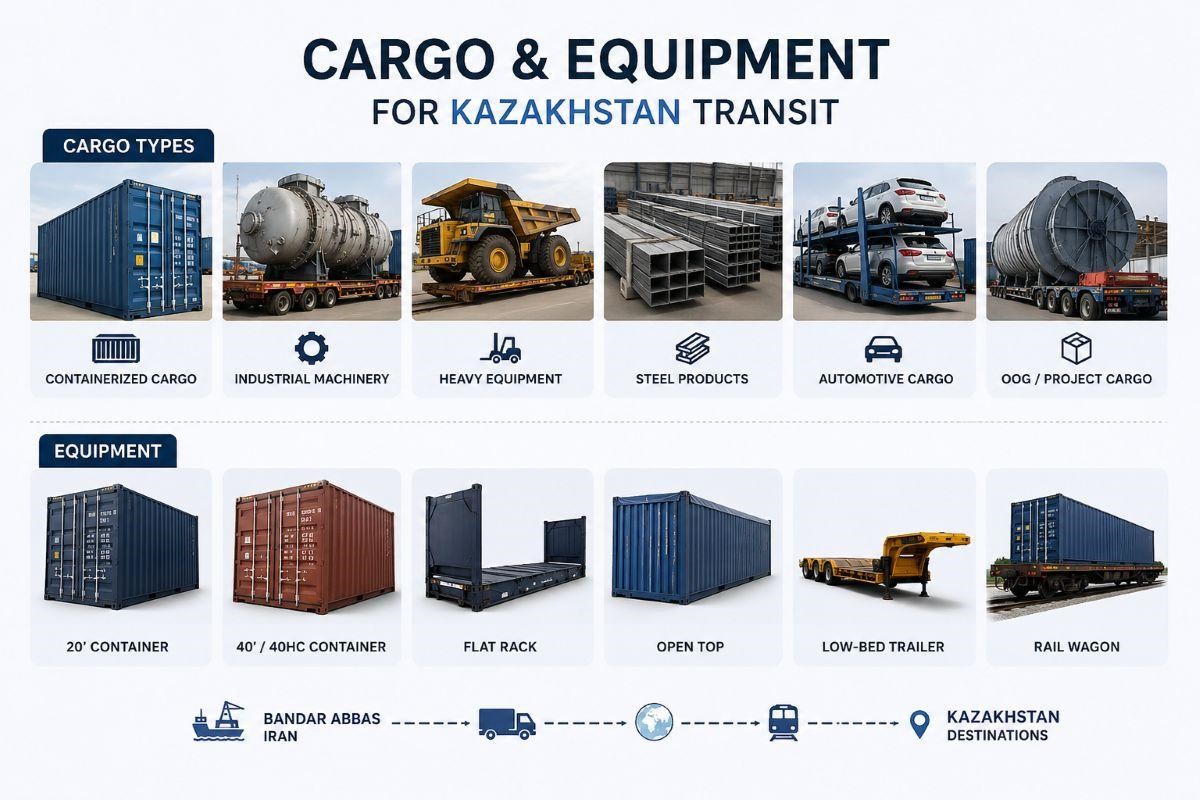
SASCO can coordinate Kazakhstan-bound transit for more than standard general cargo. Suitable shipments include containerized cargo, industrial machinery, project cargo, oversized/OOG cargo, heavy equipment, construction materials, steel products, automotive cargo, and other commercial goods, subject to cargo acceptance and route requirements.
Standard shipments may move in 20ft, 40ft, or 40HC containers. Cargo exceeding standard container dimensions can require flat rack or open top equipment, while very heavy or oversized units may need low-bed or other heavy-haulage trailers for the Iranian inland leg. Rail movements can use container wagons or other wagon types selected according to cargo weight, dimensions, and loading method.
For non-standard shipments, SASCO’s project cargo and OOG transport services cover route feasibility, equipment selection, permit coordination, loading and lashing requirements, and final-delivery planning. Axle loads, lifting points, and center of gravity may also affect equipment selection.
Documents Required for Bandar Abbas–Kazakhstan Transit
For cargo transit from Bandar Abbas to Kazakhstan, documents should be checked before the shipment leaves Shahid Rajaee Port. Requirements vary by transport mode, commodity, customs status, and whether the cargo is standard, containerized, or project-related.
Core documents normally include:
- Commercial Invoice — commodity description, value, seller, buyer, and commercial terms.
- Packing List — package count, gross weight, dimensions, and packing details.
- Bill of Lading — covers the sea leg into Bandar Abbas.
- Transit Declaration — supports customs-controlled movement through Iran.
- CMR consignment note — used for international road carriage and shipment/carrier details. UNECE CMR reference
- TIR Carnet — applicable when road transit is performed under the TIR system. IRU TIR Carnet guidance
- Certificate of Origin — where required by customs, trade rules, or the consignee.
- HS Code — should correspond with the commercial cargo description.
- Container documents — container number, ownership/status, and release information where applicable.
- OOG/project cargo specifications — dimensions, weight, center of gravity, lifting points, drawings, and handling requirements.
- Insurance documents — where cargo insurance is included in the transport arrangement.
For Iran to Kazakhstan cargo transit, information should remain consistent across the full document set. Mismatched weights, package counts, HS codes, container numbers, or consignee details can require corrections and delay port, customs, border, or terminal processing.
Step-by-Step Cargo Transit from Bandar Abbas to Kazakhstan
Cargo transit from Bandar Abbas to Kazakhstan requires coordination between the port, Iranian customs, inland transport operators, border or Caspian terminals, and the receiving side in Kazakhstan.
- Cargo arrives at Shahid Rajaee Port.
The shipment is discharged from the inbound vessel and made available for transit processing at Bandar Abbas. - Transit documents are checked.
The Bill of Lading, Commercial Invoice, Packing List, HS code, container details, and onward transport documents are reviewed for consistency before movement begins. - Iranian customs transit formalities are completed.
A transit declaration is lodged, customs inspection or verification is completed where required, and the applicable customs security or guarantee is arranged. Containers may also be sealed for bonded transit. - The Kazakhstan route is confirmed.
Based on the destination and cargo, the shipment proceeds by road, rail, or a Caspian multimodal route. The selected exit gateway must correspond with the transit documentation. - Cargo moves across Iran.
Road or rail transport carries the shipment toward the relevant Iranian exit border or to Anzali/Amirabad for Caspian transport. - Border or Caspian handover is completed.
Customs seals and documents are verified before cross-border continuation or vessel loading for Aktau. - Cargo continues to its Kazakh destination.
After entry into Kazakhstan, the shipment proceeds to Almaty, Astana, Shymkent, Aktau, Atyrau, Tengiz, or the agreed final delivery point.
2026 Update: Kazakhstan Is Building a Logistics Terminal at Bandar Abbas
A major development is strengthening the commercial importance of the Bandar Abbas–Kazakhstan corridor. On June 28, 2026, Kazakhstan and Iran signed a 27-year BOT agreement for a Kazakh transport and logistics terminal at Shahid Rajaee Port. The agreement provides two years for construction followed by 25 years of operation, with commercial commissioning scheduled for the project’s third year.
The Kazakhstan logistics terminal in Bandar Abbas is intended to strengthen the International North–South Transport Corridor and improve Kazakhstan’s access to Persian Gulf, South Asian, Southeast Asian, and East African markets. For shippers, the project further reinforces Shahid Rajaee Port’s role in future Kazakhstan–Iran transit flows.
Why Choose SASCO for Bandar Abbas–Kazakhstan Cargo Transit?
For shippers seeking a freight forwarder for Bandar Abbas to Kazakhstan cargo, SASCO can coordinate the Iranian transit leg across road, rail, and multimodal routes according to the destination and cargo profile. Operations can include coordination at Bandar Abbas and other Iranian ports, inland movement across Iran, Caspian connections to Aktau, documentation control, and handovers between transport modes or border operators.
SASCO also handles containerized cargo, industrial equipment, and project shipments that require route-specific equipment or handling. This is particularly relevant for western Kazakhstan, where cargo may move across Iran to Anzali and continue by vessel to Aktau before final inland delivery.
SASCO’s experience includes a Kazakhstan-bound multimodal project in which SOC containers were moved through Iran to Anzali, shipped across the Caspian Sea to Aktau, and then delivered to Tengiz. This provides practical route experience beyond general transit planning.
Frequently Asked Questions About Bandar Abbas to Kazakhstan Cargo Transit
How long does cargo transit from Bandar Abbas to Kazakhstan take?
Transit time varies by destination, transport mode, border conditions, equipment availability, and terminal or Caspian vessel schedules. Road, rail, and multimodal routes therefore have different operating ranges.
What is the cheapest way to ship cargo from Bandar Abbas to Kazakhstan?
For Bandar Abbas to Kazakhstan shipping, no single option is always cheapest. Rail can suit heavier or regular container volumes, while road may be more economical when direct delivery reduces extra handling.
Can cargo be shipped directly from Bandar Abbas to Aktau by sea?
No. Bandar Abbas is on the Persian Gulf and Aktau is on the Caspian Sea. Cargo must first cross Iran by road or rail to an Iranian Caspian port before sailing to Aktau.
Is road or rail freight better from Bandar Abbas to Kazakhstan?
Road offers greater scheduling and final-delivery flexibility. Rail can suit heavy cargo, containers, bulk shipments, and recurring volumes when wagon availability and terminal arrangements are suitable.
Can 20ft and 40ft containers transit from Bandar Abbas to Kazakhstan?
Yes. Standard 20ft, 40ft, and 40HC containers can move to Kazakhstan, subject to container ownership, equipment availability, border arrangements, and the selected route.
Can SASCO handle oversized cargo to Kazakhstan?
SASCO can coordinate OOG and project cargo subject to route feasibility. Such shipments may require low-bed trailers, flat racks, permits, escorts, route surveys, or special handling.
Which Kazakhstan cities can be served from Bandar Abbas?
Routes can be arranged to Almaty, Astana, Shymkent, Aktau, Atyrau, Aktobe, Tengiz, and other agreed destinations, with routing selected according to the final delivery point.
What documents are required for transit cargo through Iran to Kazakhstan?
Typical documents include the Commercial Invoice, Packing List, Bill of Lading, transit declaration, HS code, container details, CMR for road freight, TIR Carnet where applicable, and additional OOG or insurance documents when required.