

What Is Heavy-Lift Cargo?
Heavy-lift cargo is defined by engineering thresholds rather than just physical scale. It refers to individual units whose weight, geometry, or lifting configuration exceeds standard port and vessel handling limits, rendering conventional methods unsafe. Heavy-lift cargo often requires a project cargo & OOG transport service when individual units exceed standard port and vessel handling limits.
Key Engineering Thresholds
The transition from general freight to heavy-lift is triggered by three technical variables:
- Unit Weight vs. SWL: Any mass exceeding the Safe Working Load (SWL) of standard ship or shore cranes (typically $>100$ tons).
- Offset Center of Gravity (COG): Units where the COG is elevated or uncertain, demanding verified Lifting Geometry and controlled sequencing.
- Structural Point Loads: Cargo that is exceptionally dense (compact but heavy), requiring specialized load distribution to prevent pier deck or hatch cover failure.
Each heavy-lift shipment demands a verified lifting plan, risk assessment, and careful port handling to ensure stability during loading and transit.
Critical Distinction: "Oversized" refers to a spatial challenge (geometry), whereas "Heavy-Lift" is a structural and stability challenge (mass distribution). Heavy-lift cargo often moves under breakbulk operations, but the two are not equivalent. Breakbulk defines shipment method; heavy-lift defines lifting and control requirements.
When Does Cargo Become a Heavy-Lift Project?
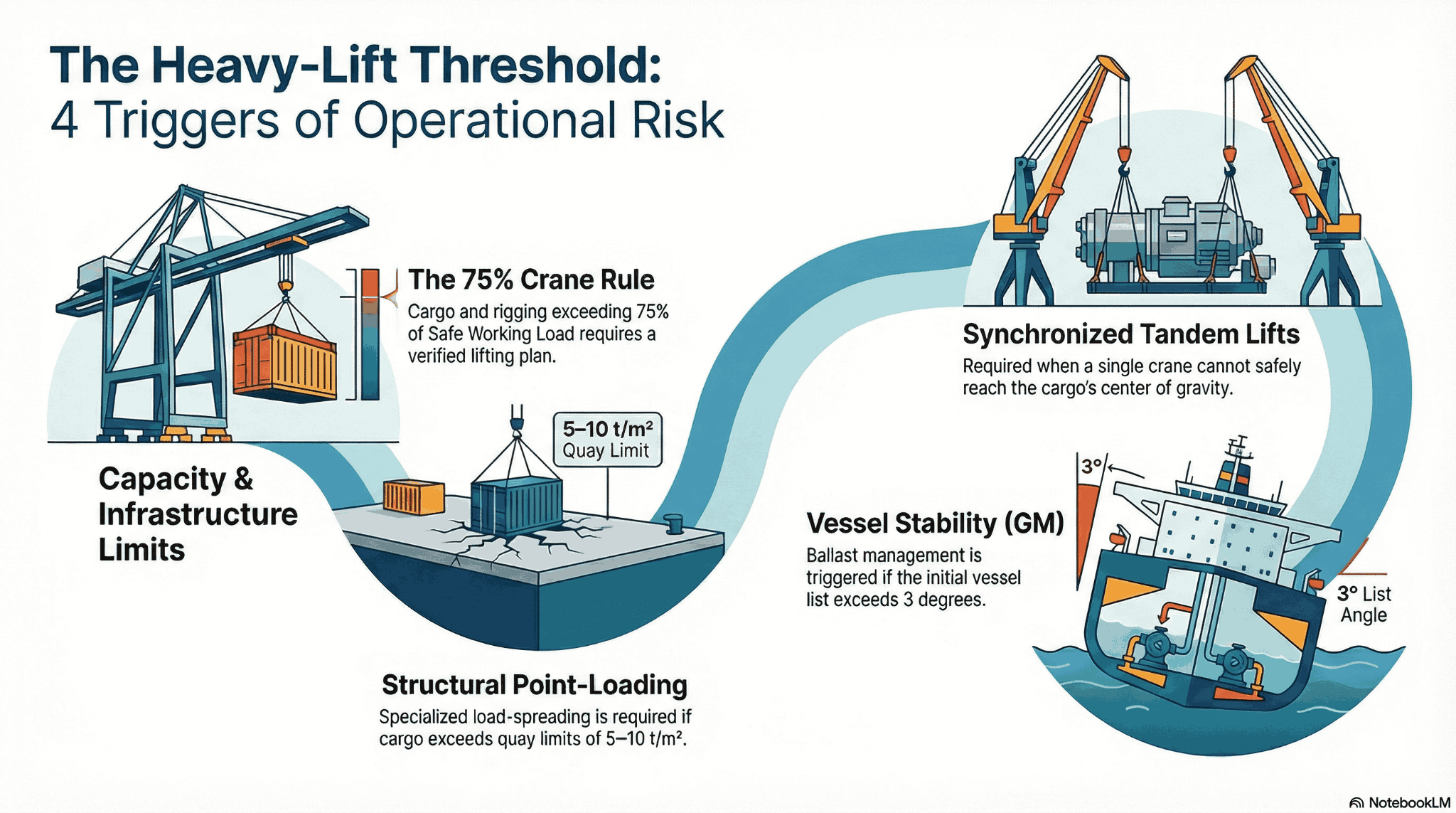
Building on the engineering thresholds outlined above, a shipment transitions from standard freight to a heavy-lift project when operational risks exceed routine port handling capacity. The transition is triggered by four critical operational criteria:
1. The 75% Utilization Rule (Crane Capacity)
A project is triggered when the combined weight of cargo and rigging gear (spreader beams, slings, shackles) exceeds 75% of the crane’s SWL at the required radius. At this threshold, dynamic factors, such as wind or hook-off impact, demand a verified lifting plan and precise radius calculations to maintain safety.
2. Structural Point-Loading & Surface Integrity
If the cargo’s footprint or crane outriggers exceed the allowable quay bearing capacity, the shipment becomes a structural engineering project. In many Iranian berths (e.g., Bandar Abbas), limits are typically 5–10 t/m². Exceeding this requires load-spreading engineering, using steel mats or specialized stools, and verification of port infrastructure to ensure ground stability.
3. The Necessity of Synchronized Tandem Lifts
When a single crane cannot safely lift the unit or reach the center of the hold, a tandem lift is required. This high-risk operation mandates a method statement coordinating crane speeds, swing radii, and communication protocols to mitigate operational hazards.
4. Vessel Stability & Metacentric Height (GM)
For sea transit, heavy-lift cargo can shift the vessel’s center of gravity, impacting stability. If the projected initial list exceeds 3°, loading cannot proceed without a ballast management plan and detailed stability calculations at each stage.
Heavy‑Lift Vessels Calling Iranian Ports
Heavy‑lift operations depend on the interaction between cargo demands and vessel capabilities. Not all ships can execute engineered heavy lifts; the vessels that do are defined by their gear, deck strength, and ability to integrate complex stability plans — especially in ports with specific lifting constraints like Bandar Abbas or Bandar Imam Khomeini.
Geared Heavy‑Lift Vessels
Vessels equipped with their own heavy‑lift cranes (often 100+ tons per crane) represent the baseline for heavy projects. These ships offer onboard power and controlled lifting capacity independent of shore equipment, which is crucial where port cranes are limited by outreach or SWL. Their gear allows precise load sequencing, reduced tandem dependence, and lower operational risk during lift‑on/lift‑off.
Semi‑Submersible and Jack‑Up Units
For extremely heavy or exceptionally shaped units, semi‑submersible vessels (which can ballast down to float cargo into position) and jack‑up barges provide engineered solutions beyond traditional lift methods. These platforms eliminate certain lifting constraints altogether by enabling direct float‑on/float‑off handling or stable lift decks above varying tidal conditions.
Iran and Sanction‑Compliant Heavy‑Lift Tonnage
Iranian ports still receive geared heavy‑lift and multipurpose vessels that are sanction‑compliant or operate within regional regulatory frameworks. These include ships with robust onboard lifting gear that can integrate with local port operations and engineered lifting plans. While their average age and SWL profiles may differ from the newest Western tonnage, their operational presence ensures that engineered heavy‑lift projects can be executed — provided that planners account for equipment limits, certification, and port handling procedures.
Iran Ports Suitable for Heavy-Lift Operations
Selecting a port for heavy-lift cargo shipping in Iran depends on structural capability and operational readiness, not mere proximity. Successful heavy-lift cargo transportation requires ports that can handle concentrated loads, maintain crane outreach, and accommodate specialized lifting procedures.
A. Reach & Lifting Capacity (Max Crane Outreach)
The primary bottleneck for heavy-lift transport services is the crane’s load chart. Lifting capacity decreases sharply as the outreach distance from the quay increases.
- Shahid Rajaee (Bandar Abbas): The premier gateway for project heavy-lift logistics. Standard container gantries are limited to TEUs, but specialized berths (e.g., Berth 35) employ Mobile Harbour Cranes (MHC) capable of up to 140 metric tons, ensuring safe handling of wide-body industrial units.
- Chabahar (Shahid Beheshti): Strategically vital for oversized and heavy cargo transport due to deep-draft berths. Newly installed high-outreach MHCs (140 tons) allow safer handling of long or irregular units from larger vessels.
B. Quay Load Limits (Structural Integrity)
Heavy-lift freight imposes significant point loads on quay surfaces. The design of the pier dictates whether heavy cargo shipping solutions can be executed safely.
- Pressure Thresholds: Iranian jetties typically tolerate 5–10 t/m² distributed load.
- Engineering Constraint: Moving a 200-ton turbine on specialized trailers may exceed these limits without load-spreading engineering.
- Execution Strategy: Ports like Bandar Imam Khomeini (BIK) require pre-approved steel plate or engineered mat plans to distribute loads and prevent quay deck damage.
C. Tidal & Weather Constraints
Heavy-lift cargo is highly sensitive to dynamic environmental factors.
- Tidal Variation: In BIK and Persian Gulf ports, tides may reach 3–5 meters, affecting vessel stability during lift-off.
- Wind Windows: Lifts are paused if wind speeds exceed 10–12 m/s to avoid destabilizing cranes or inducing a sail effect on oversized load transportation.
D. Ro-Ro vs. Lift-on/Lift-off (Lo-Lo) Feasibility
The handling method directly impacts the execution strategy:
- Lo-Lo (Lift-on/Lift-off): Required for non-wheeled units such as reactors or transformers. High-capacity geared vessels or floating cranes are used. Shahid Rajaee is the preferred Lo-Lo hub thanks to quay strength and crane reach.
- Ro-Ro (Roll-on/Roll-off): Suitable for oversized and heavy cargo transport when using Self-Propelled Modular Transporters (SPMT). Advantages include bypassing crane limitations, but a dedicated Ro-Ro ramp with compatible draft and slope is essential.
After port discharge, a specialized road freight service is often required when oversized or heavy cargo must continue inland by SPMTs or heavy-haul trailers.
Engineering & Planning Requirements
In heavy-lift cargo transportation, engineering is the only way to mitigate risk. For Iran heavy-lift logistics solutions, the following four documents are mandatory for both safety and regulatory (Port Captain) approvals:
1. Lifting Plans & Method Statements
The "how-to" guide for the operation. It must be verified before the vessel berths.
- Rigging Design: Calculation of sling angles and COG to ensure the cargo remains level.
- Method Statement: A step-by-step sequence (from hook-up to release) that synchronizes cranes, signalmen, and vessel crew.
- Equipment Certification: All specialized heavy haulage gear (slings, shackles, beams) must have valid load-test certificates.
2. Sea Fastening & Grillage
Securing the load is a critical part of any heavy-lift sea freight service during the maritime leg of heavy-lift cargo shipping.
- Grillage: Steel structures designed to distribute the unit's weight across the vessel's primary bulkheads.
- Acceleration Forces: Calculations based on IMO standards to ensure welds and stoppers resist the vessel's pitch and roll in the Persian Gulf.
3. Stability & Ballast Analysis
Ensuring the vessel stays upright during the critical "break-away" moment.
- GM (Metacentric Height): Calculations must prove the vessel maintains positive stability at all lift stages.
- Ballast Plan: A programmed sequence of pumping water between tanks to counteract the list (tilt) as the crane swings the load.
4. Regulatory & Port Captain Approvals
In Iran, heavy-lift project cargo shipping requires local authority vetting:
- Technical Vetting: The Port Captain (PMO) requires the Lifting Plan and Mooring Analysis for safety clearance.
- Equipment Bond: Temporary customs admission for specialized OOG gear (like SPMTs) must be integrated into the engineering timeline.
Risk Profile of Heavy-Lift Cargo Through Iran
-
Transporting heavy-lift cargo through Iran involves a distinct risk profile that must be managed with engineering precision, local expertise, and a dedicated transit through Iran service.
Technical Risks: Include crane capacity limits, tandem-lift coordination, ground bearing pressures, and vessel stability. Miscalculations can cause structural damage or delays.
- Regulatory Risks: Port authorities in Bandar Abbas, Chabahar, and Bandar Imam Khomeini require pre-approved lifting plans and method statements. Non-compliance leads to operational hold-ups.
- Sanctions-Related Risks: International sanctions limit access to Western heavy-lift fleets, banking channels, and certified contractors, affecting project timelines and logistics solutions.
- Insurance & P&I Exclusions: Some carriers or insurers exclude coverage for Iranian ports, demanding alternative risk mitigation strategies and a specialized cargo insurance service.
- Weather Windows: Operations are sensitive to wind, tides, and seasonal conditions. Persian Gulf ports face higher wind and tidal variations, whereas Caspian Sea ports have more predictable conditions, influencing schedule planning.
This risk framework guides safe and efficient heavy-lift cargo shipping through Iran ports.
Choosing a Heavy-Lift Logistics Partner in Iran
Selecting the right logistics partner is crucial for safe and efficient heavy-lift cargo shipping through Iran ports. Companies must demonstrate expertise in lifting engineering, port regulations, and multi-modal transport.
SASCO provides end-to-end solutions for project heavy-lift logistics, including risk assessment, lifting plan verification, and coordination with Iranian port authorities. Their experience with power plants, refineries, and mining projects ensures compliance with local and international standards while optimizing schedule and costs.
Licensed operators handle port approvals, method statements, and stability verifications, while collaborating with specialized engineering teams for lifting and sea fastening. Choosing a partner like SASCO reduces exposure to operational, regulatory, and sanctions-related risks, creating a seamless framework for heavy-lift cargo transit through Iran.