

What Are Incoterms® 2020?
Incoterms® 2020 are international trade rules published by the International Chamber of Commerce. They are used in contracts for the sale of goods to clarify how delivery responsibilities are divided between the seller and the buyer.
In practical terms, Incoterms help define who is responsible for arranging transport, paying certain costs, handling delivery, managing risk transfer, arranging cargo insurance where required, and dealing with export or import clearance obligations.
Incoterms do not replace a complete sales contract. To avoid confusion, the selected rule should always be written together with a clearly named place, port or delivery point and the correct version, for example: [Chosen Incoterm® rule] [Named place/port/point] Incoterms® 2020.
Incoterms® 2020 at a Glance
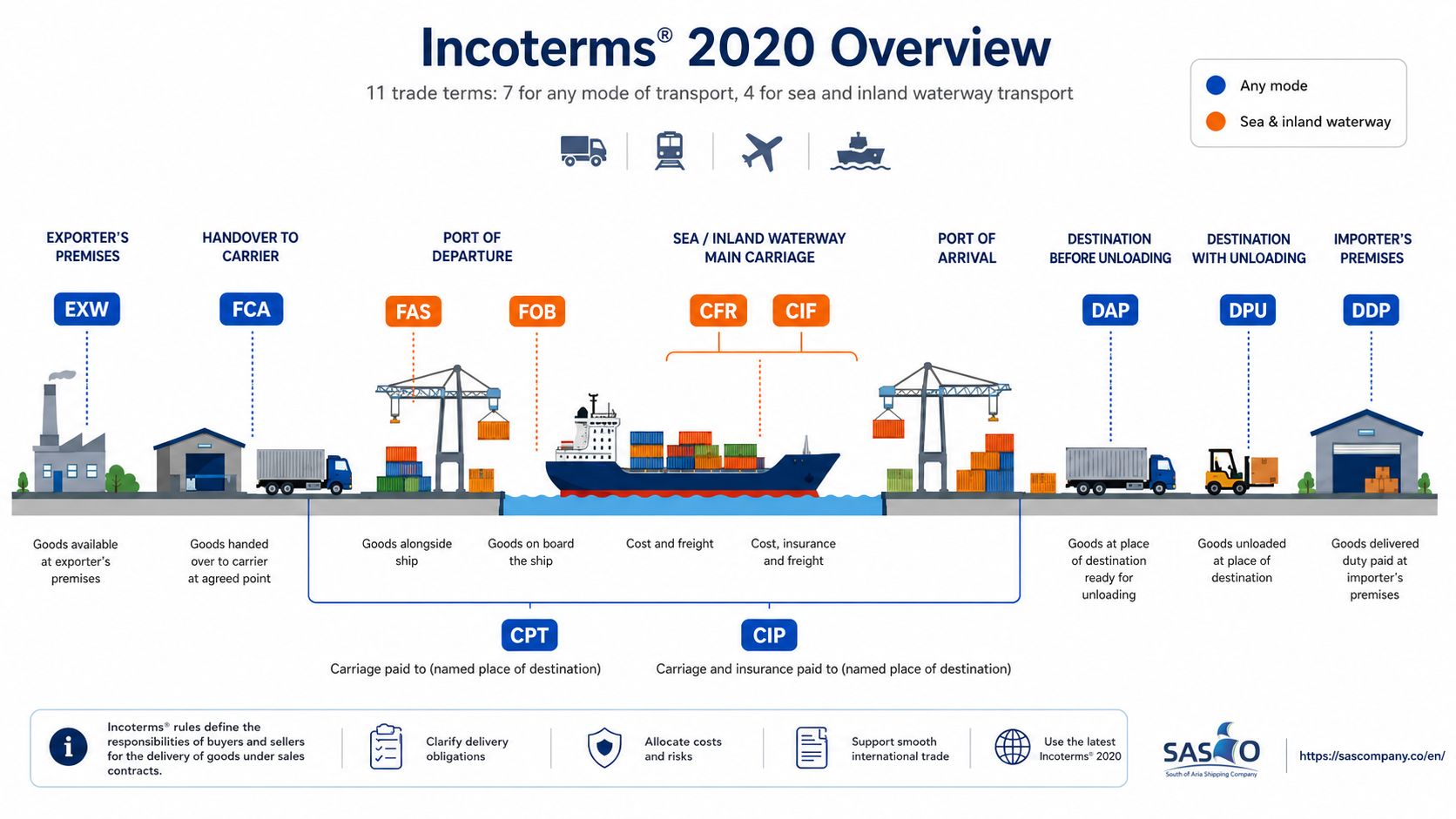
Incoterms® 2020 include 11 three-letter trade terms. Seven rules can be used for any mode of transport, including road, rail, air, sea and multimodal shipments. Four rules are designed only for sea and inland waterway transport.
|
Group |
Incoterms® 2020 Rules |
|
Any mode of transport |
EXW, FCA, CPT, CIP, DAP, DPU, DDP |
|
Sea and inland waterway transport only |
FAS, FOB, CFR, CIF |
When using Incoterms in a sales contract, the selected rule should be written together with a clearly named place, port or delivery point and the correct version. A practical format is: [Chosen Incoterm® rule] [Named place/port/point] Incoterms® 2020.
Why Incoterms Matter in Shipping
Incoterms help buyers and sellers avoid confusion by clarifying key shipping responsibilities before the cargo moves. They affect who arranges transport, who pays freight and local charges, when risk transfers from seller to buyer, and who is responsible for delivery at the agreed place.
They also help define which party handles export and import clearance obligations, whether cargo insurance must be arranged, and who is responsible for loading or unloading at specific stages of the shipment.
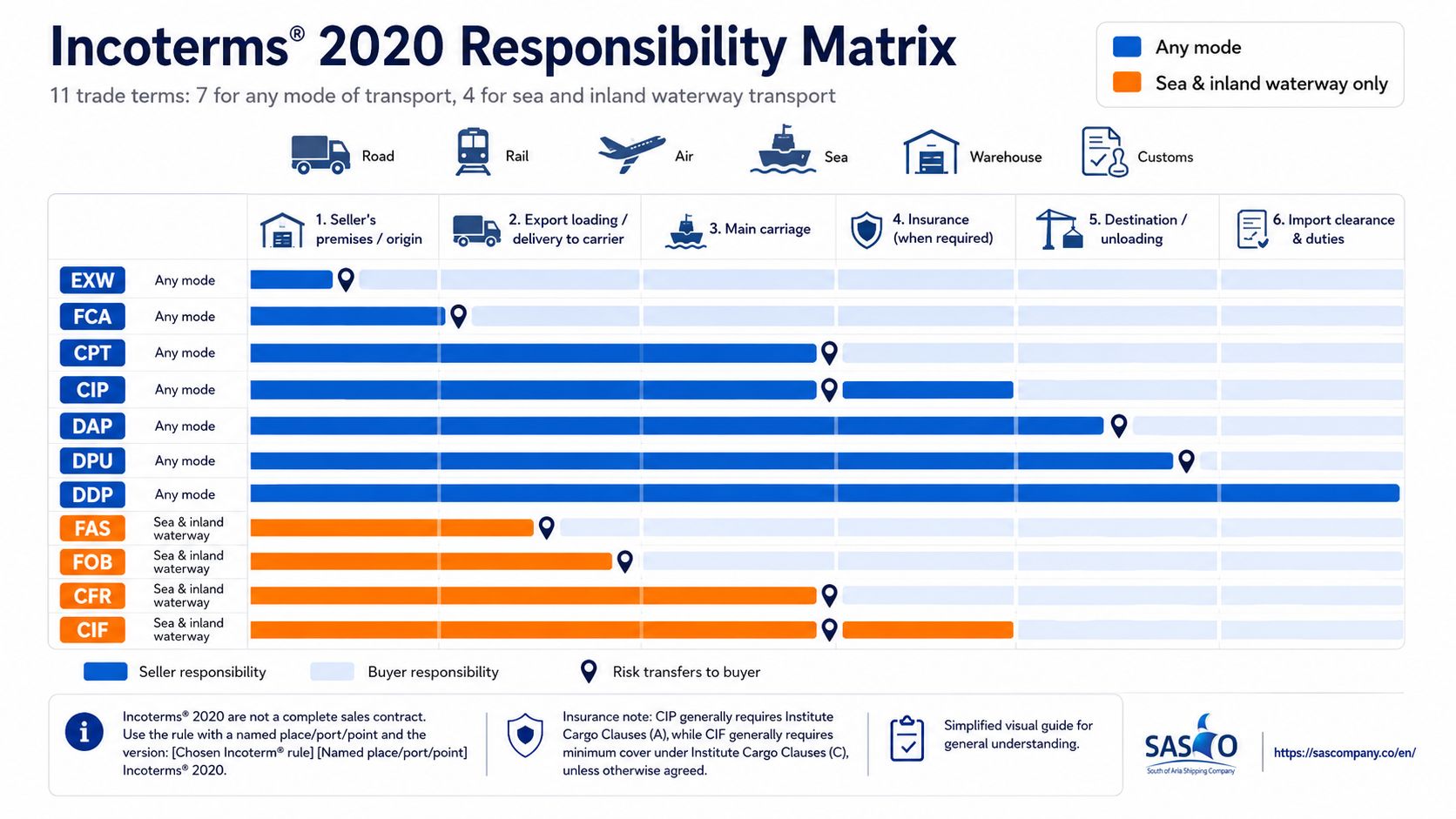
Insurance is an important point. Under Incoterms® 2020, CIP requires a higher level of insurance cover, generally Institute Cargo Clauses (A), while CIF keeps minimum cover under Institute Cargo Clauses (C), unless the parties agree otherwise.
Because Incoterms do not replace a complete sales contract, they should be used together with clear commercial terms, cargo details, payment conditions, documents, named places and route-specific requirements.
Rules for Any Mode of Transport
The following Incoterms® 2020 rules can be used for any mode of transport, including road, rail, air, sea and multimodal shipments.
EXW – Ex Works
Under EXW, the seller makes the goods available at an agreed place, usually the seller’s premises, warehouse or factory. The buyer takes responsibility for most transport arrangements, costs and risks from that point.
EXW gives the buyer maximum control, but it may create practical challenges if the buyer cannot handle export procedures or local loading requirements in the seller’s country.
FCA – Free Carrier
Under FCA, the seller delivers the goods to the carrier or another party nominated by the buyer at the named place. The seller is usually responsible for export clearance.
FCA is often more practical than EXW for international shipments, especially when the cargo is containerized or moves through several transport modes.
CPT – Carriage Paid To
Under CPT, the seller arranges and pays for transport to the named destination. However, risk transfers from the seller to the buyer when the goods are handed over to the first carrier.
This means the seller pays the main carriage, but the buyer carries the transport risk after delivery to the carrier.
CIP – Carriage and Insurance Paid To
Under CIP, the seller arranges and pays for transport to the named destination and also provides cargo insurance for the buyer’s benefit. As with CPT, risk transfers when the goods are handed over to the first carrier.
Under Incoterms® 2020, CIP requires a higher level of insurance cover, generally Institute Cargo Clauses (A), unless the parties agree otherwise.
DAP – Delivered at Place
Under DAP, the seller delivers the goods to the named destination, ready for unloading. The seller carries the main transport responsibility and risk up to that agreed place.
The buyer is usually responsible for unloading, import clearance, import duties and taxes, unless the contract states otherwise.
DPU – Delivered at Place Unloaded
Under DPU, the seller delivers the goods to the named destination and is responsible for unloading them there. This is the only Incoterms® 2020 rule where unloading at the destination is the seller’s responsibility.
DPU can be useful when the seller is able to control delivery and unloading at the final place, terminal, warehouse or project site.
The buyer usually remains responsible for import clearance, import duties and taxes, unless otherwise agreed.
DDP – Delivered Duty Paid
Under DDP, the seller takes the highest level of responsibility. The seller arranges transport, handles export and import clearance, and delivers the goods to the named destination with duties and taxes paid.
DDP can be convenient for the buyer, but it requires the seller to understand the import rules, tax requirements and customs procedures in the destination country.
Rules for Sea and Inland Waterway Transport
The following four Incoterms® 2020 rules are intended only for sea and inland waterway transport. They are generally used when goods are delivered alongside or on board a vessel at a port.
FAS – Free Alongside Ship
Under FAS, the seller delivers the goods alongside the vessel at the named port of shipment. From that point, the buyer takes responsibility for loading the goods on board, main carriage, costs and risks.
FAS is mainly used for cargo that is delivered directly alongside the ship, such as bulk, breakbulk or certain project cargo shipments.
FOB – Free on Board
Under FOB, the seller delivers the goods on board the vessel at the named port of shipment. Risk transfers from the seller to the buyer once the goods are on board the vessel.
FOB is widely used in sea freight, but it should be applied carefully, especially for containerized cargo where FCA may often be more practical.
CFR – Cost and Freight
Under CFR, the seller arranges and pays for sea freight to the named port of destination. However, risk transfers to the buyer once the goods are loaded on board the vessel at the port of shipment.
This means the seller pays the ocean freight, but the buyer carries the risk during the sea voyage.
CIF – Cost, Insurance and Freight
Under CIF, the seller arranges and pays for sea freight to the named port of destination and also provides cargo insurance for the buyer’s benefit. Risk transfers to the buyer once the goods are loaded on board the vessel at the port of shipment.
Under Incoterms® 2020, CIF keeps the minimum insurance requirement of Institute Cargo Clauses (C), unless the parties agree on a higher level of cover.
Important Insurance Note
Under Incoterms® 2020, CIP requires a higher level of insurance cover than CIF. CIP generally requires Institute Cargo Clauses (A), while CIF requires minimum cover under Institute Cargo Clauses (C), unless the parties agree otherwise.
This difference is important when choosing Incoterms for high-value cargo, sensitive goods, project cargo, containerized shipments or routes with multiple handling points.
How to Choose the Right Incoterm
Choosing the right Incoterm depends on how much control, cost and responsibility each party wants to take during the shipment. Before agreeing on an Incoterm, buyers and sellers should review the cargo route, transport mode, customs requirements, delivery point and insurance needs.
A practical way to choose the right Incoterm is to clarify these questions before the shipment is booked:
- Do you want the seller or the buyer to control the main freight?
- Who has better access to reliable freight rates, carriers and local agents?
- Which party is better positioned to handle export and import clearance?
- Is cargo insurance required, and what level of cover is suitable for the shipment?
- Is the cargo containerized, bulk, breakbulk, oversized, temperature-sensitive or project cargo?
- Is the route limited to sea freight, or does it involve road, rail, inland transport or multimodal logistics?
- Are there any transit, port handling, inland delivery, documentation or customs-related issues that may affect the shipment?
The right Incoterm should match the commercial agreement, the route structure and the operational reality of the shipment. A term that works well for one cargo movement may not be suitable for another route, cargo type or destination.
Important Notes for Shipments Involving Iran
For shipments involving Iran, the selected Incoterm should be reviewed together with the full logistics route, customs procedures, port operations, transit documentation, inland transportation, cargo handling requirements and final delivery conditions.
This is especially important for import, export, transit and multimodal cargo, where responsibilities may be shared across sellers, buyers, carriers, customs brokers, ports, inland transport providers and logistics coordinators.
SASCO supports cargo owners, traders, importers and exporters with freight forwarding, sea freight, NVOCC, customs clearance, transit and multimodal logistics for shipments connected to Iran and international trade routes. With operational experience across port, customs, transit and inland transport processes, SASCO helps clients plan and coordinate cargo movements with greater clarity and reliability.
Need Incoterms Support for Your Shipment?
Choosing the right Incoterm can help reduce misunderstandings, unexpected costs and operational delays. SASCO can review your shipment route, cargo type, customs requirements and delivery conditions to help you plan a clearer logistics process.
Request Freight Consultation
Disclaimer
This page provides general information about Incoterms® 2020 and does not replace the official ICC Incoterms® rules, legal advice or contract-specific consultation. Parties should always refer to the official ICC publication and seek professional advice before agreeing on Incoterms in commercial contracts.
Official ICC Resources:
For the official Incoterms® 2020 rulebook and the practical ICC wallchart covering obligations, costs and risks under the 11 Incoterms® rules, please refer to the International Chamber of Commerce resources.