

Understanding Time-Sensitive Project Cargo in Iran
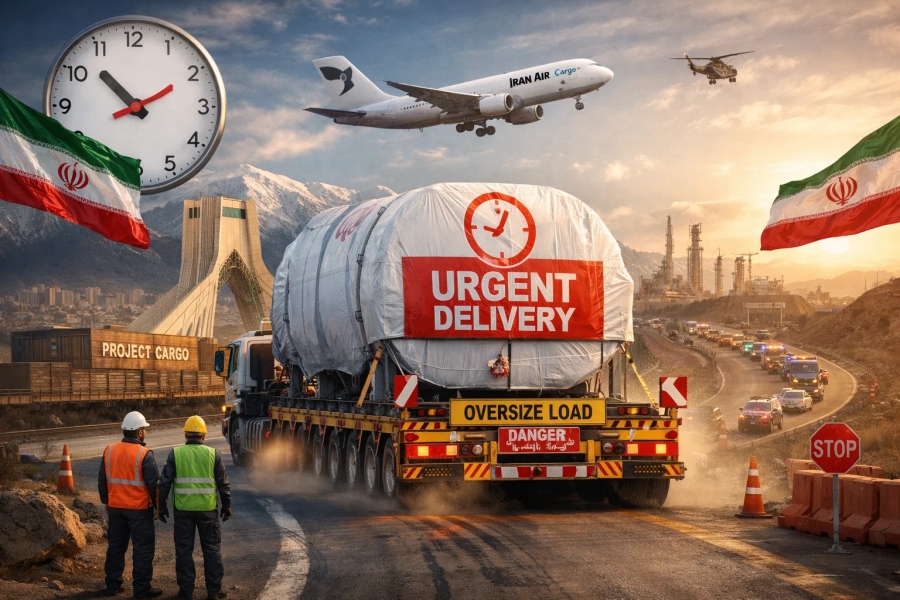
Time-sensitive project cargo refers to oversized, heavy, or high-value equipment that must be transported within a strictly defined timeframe, where even minor delays can disrupt an entire industrial or infrastructure project. Unlike standard project cargo, the defining factor here is not only size or complexity, but the critical dependency on time-bound project milestones. In transit corridors such as Iran, this time dependency becomes a decisive logistical variable.
In the context of Iran, time-sensitive project cargo is commonly associated with EPC projects in the energy, petrochemical, mining, and infrastructure sectors. Equipment such as turbines, reactors, pressure vessels, or modular units often arrive as part of a tightly sequenced construction schedule. A delay at any point—port discharge, customs clearance, inland transit, or border crossing—can halt downstream activities and generate cascading cost overruns.
Logistics requirements for time-sensitive cargo in Iran extend beyond transportation assets. Early-stage coordination with customs authorities, accurate cargo classification, and advance documentation preparation are essential to avoid procedural delays. Multimodal synchronization—particularly between sea, road, and rail—must be planned as a single, integrated operation rather than independent legs.
Why Iran Is a Strategic Corridor for Time-Critical Cargo
Geopolitical Advantage in Major Corridors
Iran’s geography is a natural logistics shortcut, sitting at the junction of the International North-South Transport Corridor (INSTC) and the East-West Silk Road. For global EPC projects, time-sensitive project cargo transit in Iran offers a geographical land bridge that can shorten transit times by 7 to 10 days compared to traditional maritime routes via the Suez Canal.
Direct Connectivity to Key Markets
The strategic advantage of project cargo logistics in Iran lies in its direct connectivity to China, Central Asia, the CIS region, and the Persian Gulf. By utilizing Iran project cargo services, shipments moving from Eastern China to markets like Azerbaijan or Kazakhstan can arrive 3 to 5 days faster than via alternative southern corridors. This directness is essential for urgent project cargo in Iran, where bypassing congested maritime hubs is a priority.
Time and Operational Advantages
Beyond geography, the corridor provides significant operational advantages. By integrating a road freight service with rail and port infrastructure, Iran allows for fast-track project cargo movement with minimized handling delays. For deadline-driven project logistics, this multimodal reliability transforms Iran from a simple transit point into a strategic tool for maintaining project continuity and reducing operational complexity.
Key Challenges of Time-Sensitive Transit in Iran
Customs and Documentation Velocity
The primary risk to time-sensitive project cargo transit in Iran is often administrative. Discrepancies in HS codes or complex "Exemption List" procedures can halt a shipment for weeks. Efficient project cargo logistics in Iran require a partner who conducts pre-clearance audits to ensure the bureaucratic clock doesn't outrun the project clock.
Infrastructure and Topographical Bottlenecks
While main corridors are robust, the "Last Mile" to remote sites often involves low-clearance tunnels or bridges with limited load-bearing capacities. For urgent project cargo in Iran, these are potential dead ends. A specialized project cargo & OOG transport service mitigates this through mandatory route surveys and temporary modifications to the path for oversized loads. .
Complex Multimodal Synchronization
True efficiency in high-priority cargo transit in Iran requires switching between sea, rail, and road. The challenge is the "Handover"—the moment cargo moves from a vessel to a hydraulic trailer. Without precise deadline-driven project logistics coordination, these interchange points become synchronization gaps where precious days are lost.
Regulatory and Financial Planning Risks
The international regulatory environment adds a layer of complexity to time-critical project cargo in Iran, particularly regarding insurance and freight payments. For high-value or oversized cargo, a cargo insurance service should be reviewed early so coverage aligns with the transit route, cargo value, and regulatory constraints. Managing this requires a strategic partner with a compliant network that can maintain project continuity despite global financial fluctuations.
Critical Factors in Planning Time-Sensitive Project Cargo
1. Route Selection Based on Time SLAs
Choosing the right transit route in Iran is critical for time-sensitive project cargo. Routes must be evaluated not only for distance, but for reliability, regulatory predictability, and ability to meet Service Level Agreements (SLAs) on delivery. The fastest path is not always the most direct; planners must balance speed with operational risk.
2. Proactive Permits and Transit Planning
Early coordination with authorities and proper scheduling of permits and transit approvals is essential. Pre-arranged clearances minimize hold-ups at border crossings or inland checkpoints, ensuring the cargo moves according to the planned timeline.
3. Role of Pre-Clearance and Documentation
Pre-clearance procedures allow project cargo to be processed before arrival, significantly reducing delays at ports or customs. Accurate HS codes, advance documentation, and compliance with local regulations are non-negotiable for deadline-driven project logistics in Iran.
4. Importance of Contingency Planning
Even with optimal planning, unexpected delays can occur. Contingency plans—alternative routes, backup carriers, or temporary storage solutions—help mitigate risks and maintain project continuity. Incorporating these measures into the initial logistics plan is crucial for all time-critical project shipments.
Customs Clearance and Regulatory Considerations
1. Project-Specific Customs Procedures
Customs clearance for project cargo differs significantly from standard commercial shipments. In Iran, oversized, heavy, or high-value equipment often falls under special customs regimes, including temporary import, transit declarations, or exemption-based procedures linked to EPC and industrial projects. These processes require prior coordination with customs authorities and cannot be handled effectively after cargo arrival.
2. Documents That Cause the Most Delays
The most common delays in time-sensitive project cargo transit are caused by documentation inconsistencies rather than physical inspections. Critical documents include HS code classifications, packing lists for oversized units, certificates of origin, transit permits, and project-related exemption approvals. Even minor discrepancies—such as mismatched weights, dimensions, or cargo descriptions—can suspend clearance and disrupt tightly planned delivery schedules.
3. Minimizing Clearance Time Through Pre-Planning
Reducing customs clearance time depends on advanced documentation and pre-clearance strategies. Submitting cargo details before arrival, validating HS codes in advance, and aligning documentation with actual transport configurations significantly shorten clearance windows. Close coordination between logistics planners, customs brokers, and project stakeholders ensures that regulatory procedures support—not hinder—deadline-driven project logistics.
For a deeper understanding of procedures, permits, and regulatory frameworks, refer to our detailed article on Iran customs clearance regulations, which explains project-specific clearance processes in greater operational detail.
Why Choosing the Right Logistics Partner Matters
In time-sensitive project cargo transit, the logistics partner is not a support function but a time-control mechanism. The ability to protect delivery schedules depends less on transport speed and more on who is managing execution, coordination, and risk in real time. This makes the distinction between different types of logistics providers a critical decision point.
Freight Forwarder vs. Project Logistics Provider
In time-sensitive project cargo logistics, the gap between a standard freight forwarder and a project logistics provider is operational depth. While a forwarder focuses on booking and documentation, a project logistics provider manages end-to-end execution—route engineering, asset allocation, regulatory coordination, and schedule control. For deadline-driven project cargo, this difference directly impacts delivery reliability.
Local Expertise and Operational Networks
Successful transit through Iran depends on local experience and executable relationships—with ports, customs brokers, transport authorities, and on-ground contractors. Familiarity with route constraints, approval workflows, and real-world operating conditions reduces friction and prevents avoidable delays in time-critical project cargo transit.
Fast Decision-Making Under Uncertainty
Unplanned events—weather disruptions, equipment availability issues, or regulatory pauses—require immediate, informed decisions. A capable partner operates with predefined escalation paths and contingency options, enabling rapid adjustments without compromising project timelines.
For projects where timing defines outcomes, working with an experienced provider like SASCO ensures execution is guided by local insight, structured risk control, and responsive decision-making—without adding unnecessary complexity.