

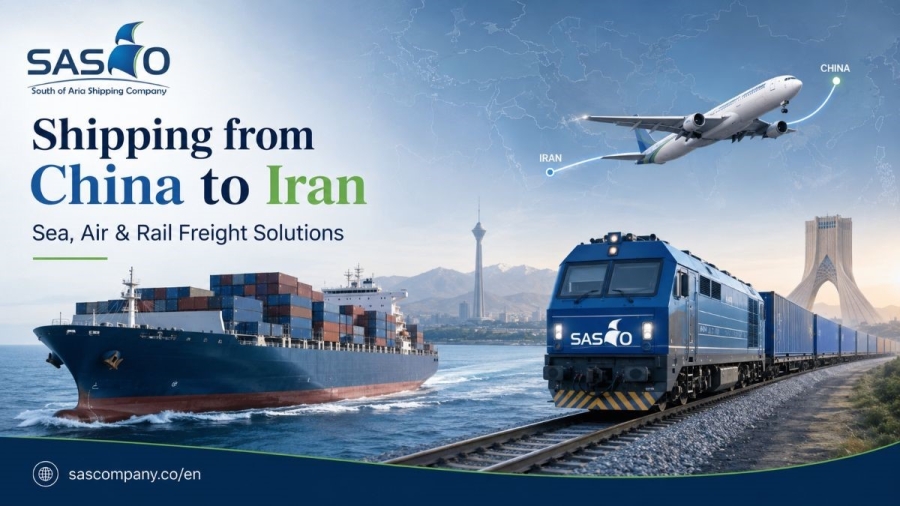
China-to-Iran Shipping Methods at a Glance
The most suitable shipping method from China to Iran depends mainly on the cargo volume and characteristics, required delivery time and available budget. The table below compares the main transport options in terms of typical transit time, relative cost, suitable cargo types and key limitations.
|
Method |
Typical transit time |
Relative cost |
Best for |
Main limitation |
|
Sea freight |
Approximately 20–45 days, port-to-port |
Low |
Heavy cargo, FCL and LCL shipments |
Longer transit time and dependence on vessel schedules |
|
Air freight |
Approximately 3–10 working days, airport-to-airport |
High |
Urgent, lightweight and high-value cargo |
Chargeable weight, airline capacity and cargo restrictions |
|
Rail freight |
Approximately 15–20 days, terminal-to-terminal |
Medium |
Containerized and medium- to high-value cargo |
Fixed schedules, capacity and border handling |
|
Multimodal transport |
Route-dependent |
Medium |
Cargo with complex origins or final destinations |
More handovers and coordination points |
These transit times are indicative planning ranges rather than guaranteed delivery times. Actual timing may vary depending on routing, service schedules, transshipment, seasonal capacity and customs procedures. Unless otherwise stated, the estimates refer only to the main international transport leg.
How Much Does Shipping from China to Iran Cost?
The cost of freight from China to Iran depends on the transport mode, cargo weight and volume, origin and destination, commodity type, required delivery time and service scope. The agreed Incoterm also affects the quotation because it determines which transport and delivery expenses are assigned to the buyer or seller.
Air freight from China to Iran is generally the most expensive option, while sea freight is usually more economical for heavy or high-volume cargo. LCL shipping from China to Iran is normally priced according to cargo volume or weight, whereas FCL shipping from China to Iran is quoted per container. Rail freight may be calculated per container, CBM or ton, depending on the available service.
Businesses planning to import goods from China to Iran should not compare quotations only by looking at the international freight rate. A low headline price may exclude pickup, terminal handling, destination services or delivery in Iran. The more useful comparison is the total end-to-end logistics cost and the exact services included in each quotation.
Indicative Freight Rates from China to Iran — Late June 2026
The following figures are public market indications collected in late June 2026. They are intended for preliminary budgeting only and should not be treated as bookable quotations. Actual rates depend on the carrier, sailing date, cargo type, weight, container availability, routing and included charges.
|
Transport mode and route |
Pricing basis |
Public market indication |
Typical service scope |
|
Shanghai to Bandar Abbas — sea freight |
20GP container |
USD 5,000–6,200 |
FCL ocean freight benchmark |
|
Shenzhen/Yantian to Bandar Abbas — sea freight |
20GP container |
Around USD 5,800 |
FCL ocean freight benchmark |
|
Ningbo to Bandar Abbas — sea freight |
20GP container |
Around USD 6,200 |
FCL ocean freight benchmark |
|
Shenzhen/Yantian to Bandar Abbas — sea freight |
40GP or 40HC |
Around USD 6,650 |
FCL ocean freight benchmark |
|
Shanghai or Ningbo to Bandar Abbas — sea freight |
40GP or 40HC |
Around USD 8,200 |
FCL ocean freight benchmark |
|
Major Chinese ports to Bandar Abbas — LCL |
Per CBM |
Approximately USD 75–210 per CBM |
Port-to-port or CFS-to-CFS |
|
Shanghai or Shenzhen to Tehran IKA — air freight |
Per chargeable kg |
Approximately USD 4.50–6.00/kg |
Airport-to-airport, general cargo |
|
Guangzhou to Tehran IKA — air freight |
Per chargeable kg |
Approximately USD 5.00–6.50/kg |
Airport-to-airport, general cargo |
|
Beijing to Tehran IKA — air freight |
Per chargeable kg |
Approximately USD 5.50–7.00/kg |
Airport-to-airport, general cargo |
|
Xi’an to Tehran/Aprin — rail freight |
20ft container |
Approximately USD 3,800–4,800 |
Terminal-to-terminal indication |
|
Xi’an to Tehran/Aprin — rail freight |
40ft container |
Approximately USD 6,800–8,200 |
Terminal-to-terminal indication |
|
Chengdu or another Chinese rail hub to Tehran — rail LCL |
Per CBM |
Approximately USD 180–280 per CBM |
Terminal-to-terminal indication |
|
Transport mode and route |
Pricing basis |
Public market indication |
Typical service scope |
|
Shanghai to Bandar Abbas — sea freight |
20GP container |
USD 5,000–6,200 |
FCL ocean freight benchmark |
Important: These figures normally do not include all origin charges, Iranian destination handling, customs clearance, duties and taxes, storage, inspection, cargo insurance or final inland delivery unless these services are specifically stated in the quotation.
Iran-bound freight rates can change rapidly. Importers should therefore request a dated and itemized quotation showing the Incoterm, route, carrier, equipment type, quotation validity, included surcharges, free time and excluded destination charges.
How China-to-Iran Freight Costs Are Calculated
|
Mode |
How the price is normally calculated |
|
Air freight |
Per chargeable kilogram |
|
LCL sea freight |
Per CBM or weight/measurement unit |
|
FCL sea freight |
Per 20GP, 40GP or 40HC container |
|
Rail freight |
Per container, CBM or ton, depending on the service |
|
Inland delivery |
Vehicle type, distance, cargo weight and loading requirements |
China to Iran freight rates can change according to carrier capacity, fuel costs, seasonal demand, routing and cargo characteristics.Two quotations for the same shipment may differ because one covers only port-to-port or terminal-to-terminal transport, while the other includes pickup, documentation, destination handling or inland delivery. The lower quotation is not necessarily the less expensive option after all additional charges are considered.
Potential Cost Components in a China-to-Iran Freight Quote
The charges shown in a China-to-Iran freight quotation depend on the agreed Incoterm and scope of service. Not every quotation includes all of the following items.
Origin charges in China
- factory pickup and domestic transport;
- export customs clearance;
- documentation and origin terminal charges.
Main freight charges
- international sea, air or rail freight;
- carrier, fuel and route-related surcharges;
- transshipment charges, where applicable.
Destination charges in Iran
- terminal handling and delivery order fees;
- Lift On/Lift Off charges, where applicable;
- LCL stripping or deconsolidation;
- customs brokerage;
- inland delivery.
Conditional or additional charges
- cargo insurance and inspection;
- storage, demurrage and detention;
- duties and taxes;
- special cargo handling.
Conditional charges are normally payable only when the relevant service is required or the charge is incurred. Storage, demurrage and detention generally apply when the cargo or equipment exceeds the applicable free-time period.
Freight Rate vs Total End-to-End Logistics Cost
The freight rate generally refers to the main charge for moving cargo between two ports, airports or terminals. The total end-to-end logistics cost may also include origin charges, destination handling, documentation, customs-related services, insurance and final delivery.
This distinction is especially important when comparing a port-to-port quotation with a door-to-door service.
How to Compare China-to-Iran Freight Quotations
When comparing quotations from freight forwarders for China-to-Iran shipments, importers should request a written breakdown showing:
- the applicable Incoterm and named place or port;
- the origin, destination, carrier and routing;
- the service scope, such as port-to-port or door-to-door;
- the pricing basis, such as chargeable weight, CBM or container size;
- the included origin and destination charges;
- the quotation validity, free time, payment terms and exclusions.
A clear quotation should show not only the main freight charge, but also which expenses remain payable by the shipper or consignee.
Sea Freight from China to Iran
Sea freight from China to Iran is usually the most economical option for heavy, bulky or high-volume cargo. It can be arranged as Full Container Load (FCL), Less than Container Load (LCL) or, for non-standard shipments, through special containers and project cargo solutions. The right choice depends on cargo volume, weight, dimensions, loading requirements, port access and the final destination in Iran.
FCL vs LCL Shipping from China to Iran
FCL shipping from China to Iran means that one shipper reserves an entire container. A 20GP container is often suitable for dense or heavy cargo, while a 40GP provides more internal capacity for larger shipments. A 40HC offers additional height and volume and is generally more suitable for bulky but relatively light goods.
Container selection should be based on packed dimensions, total CBM, gross weight, payload limits and whether the cargo can be stacked safely. Importers booking a shipping container from China to Iran should compare the usable container dimensions with the actual cargo layout rather than choosing only by carton or pallet count.
LCL shipping from China to Iran is usually more economical when the shipment is too small to justify a full container. The cargo shares container space with other consignments, and the rate is normally based on volume or weight/measurement. However, consolidation, deconsolidation, warehouse handling and destination charges may reduce the expected saving. For some medium-sized shipments, an FCL quotation can become competitive even when the container is not completely full.
For a closer comparison of shipment size, cargo control and consolidation, see our guide to FCL vs LCL shipping.
Cargo characteristics also matter. Fragile, irregularly shaped, non-stackable or high-value goods may require more space or handling control. Importers can review the dimensions and applications of 20ft, 40ft, High Cube, Open Top and Flat Rack equipment in SASCO’s container guides.
Main Chinese Ports
Common origin ports include Shanghai, Ningbo, Shenzhen/Yantian, Guangzhou/Nansha, Qingdao, Tianjin and Xiamen. The best origin is not always the largest port. The factory location, domestic trucking cost, carrier schedule, equipment availability, routing and selected Iranian destination should be considered together.
For example, routing cargo through Shanghai may be inefficient if the supplier is located much closer to Ningbo, Qingdao or Shenzhen. When goods are collected from several suppliers, the consolidation point may also influence the most practical port.
Main Iranian Seaports
Bandar Abbas, especially the Shahid Rajaee port complex, is usually the main destination for China to Bandar Abbas shipping and containerized imports. It has established container-handling capacity and inland connections to Tehran and other industrial and commercial centres.
Other ports may be suitable in specific cases:
- Chabahar for selected regional routes, transit movements and project cargo;
- Bushehr for some regional services and cargo destined for southern or central markets;
- Bandar Imam Khomeini for bulk, industrial and other cargo suited to its facilities and inland connections.
These ports are not interchangeable. Carrier access, sailing schedules, LCL availability, cargo type, customs requirements and final inland delivery all affect the decision. A lower ocean rate to one port may not result in the lowest total logistics cost if inland transport or handling is more expensive.
Direct Service vs Transshipment
A direct or carrier-operated service generally involves fewer handling points and may simplify tracking, documentation and schedule planning. A transshipment service moves cargo through an intermediate hub before continuing to Iran. It may provide more routing options, but it can also add connection risk, handling exposure and schedule variability.
Importers should confirm whether a quotation is based on a direct service, a carrier-operated connection or third-country transshipment. A switch Bill of Lading should be used only when legally permitted, commercially justified and fully compliant with applicable regulations.
For a fuller explanation of document functions, cargo release procedures and switch-document risks, see our guide to Bills of Lading and transport documents in Iran.
The shipping time from China to Iran by sea should also be defined clearly. Port-to-port time covers the main maritime movement, while door-to-door transit may also include factory pickup, origin handling, destination procedures and inland delivery.
For FCL, LCL and special-container support, see SASCO’s sea freight services in Iran.
Air Freight from China to Iran
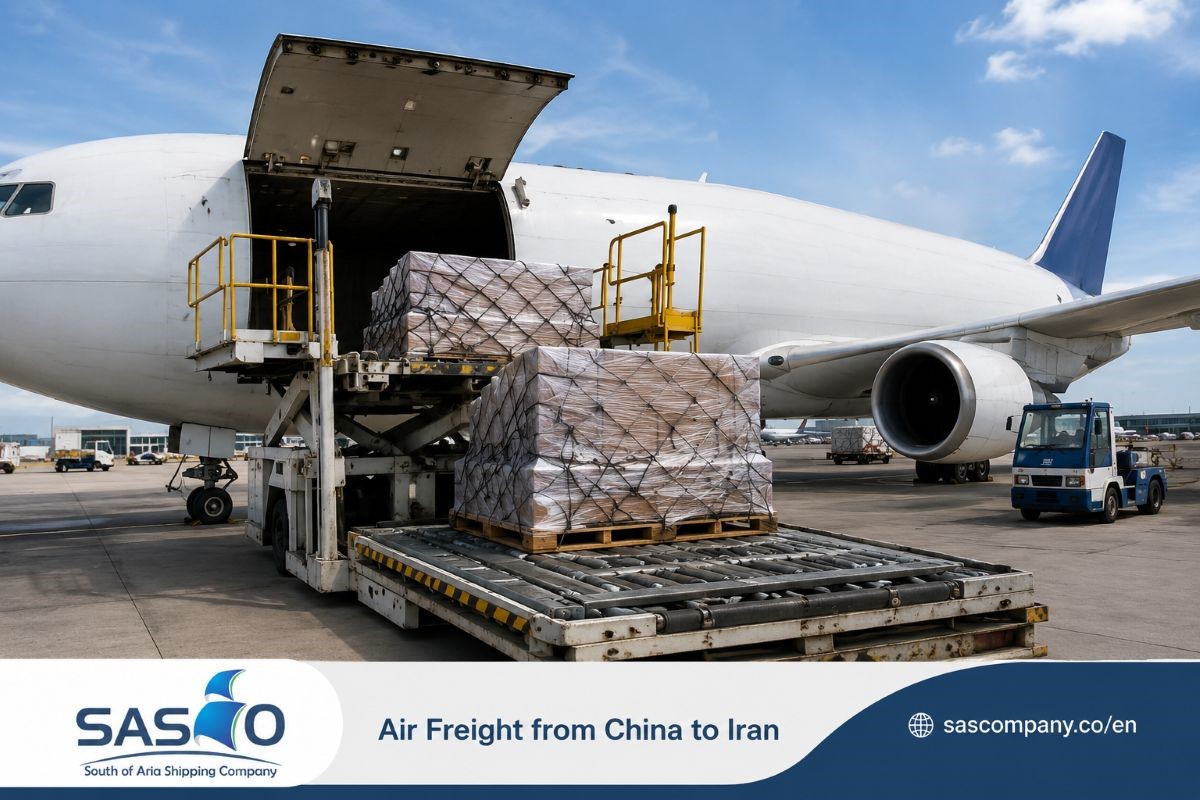
Air freight from China to Iran is suitable for urgent, high-value, lightweight or operationally critical cargo. Common departure airports include Shanghai Pudong (PVG), Guangzhou Baiyun (CAN), Shenzhen Bao’an (SZX) and Beijing Capital (PEK). Hong Kong International Airport (HKG) may also be considered when the routing and cargo acceptance conditions are suitable.
The main Iranian destination is Imam Khomeini International Airport (IKA), serving Tehran and connecting with inland distribution to other regions. Depending on airline availability, cargo may move on a direct or connecting service.
The shipping time from China to Iran by air should be identified as airport-to-airport, airport-to-door or door-to-door. A short flight schedule does not necessarily include supplier pickup, export processing, connection time, import handling or final delivery.
Air freight is normally charged according to the greater of actual gross weight and volumetric weight. For example, a carton measuring 100 × 80 × 60 centimetres has a volumetric weight of 80 kg when a divisor of 6,000 is used. If the actual weight is 55 kg, the chargeable weight would normally be 80 kg. The applicable divisor should always be confirmed with the selected airline or freight forwarder.
Cargo acceptance must be checked before booking. Batteries, magnets, liquids, powders and dangerous goods may require special packaging, technical documents or airline approval. Sensitive or temperature-controlled cargo may also require a dedicated handling plan. Typical air documentation includes the Air Waybill and pre-alert information sent to the destination team before arrival.
SASCO’s air freight services in Iran include booking coordination, documentation support, airport handling, customs coordination and delivery planning.
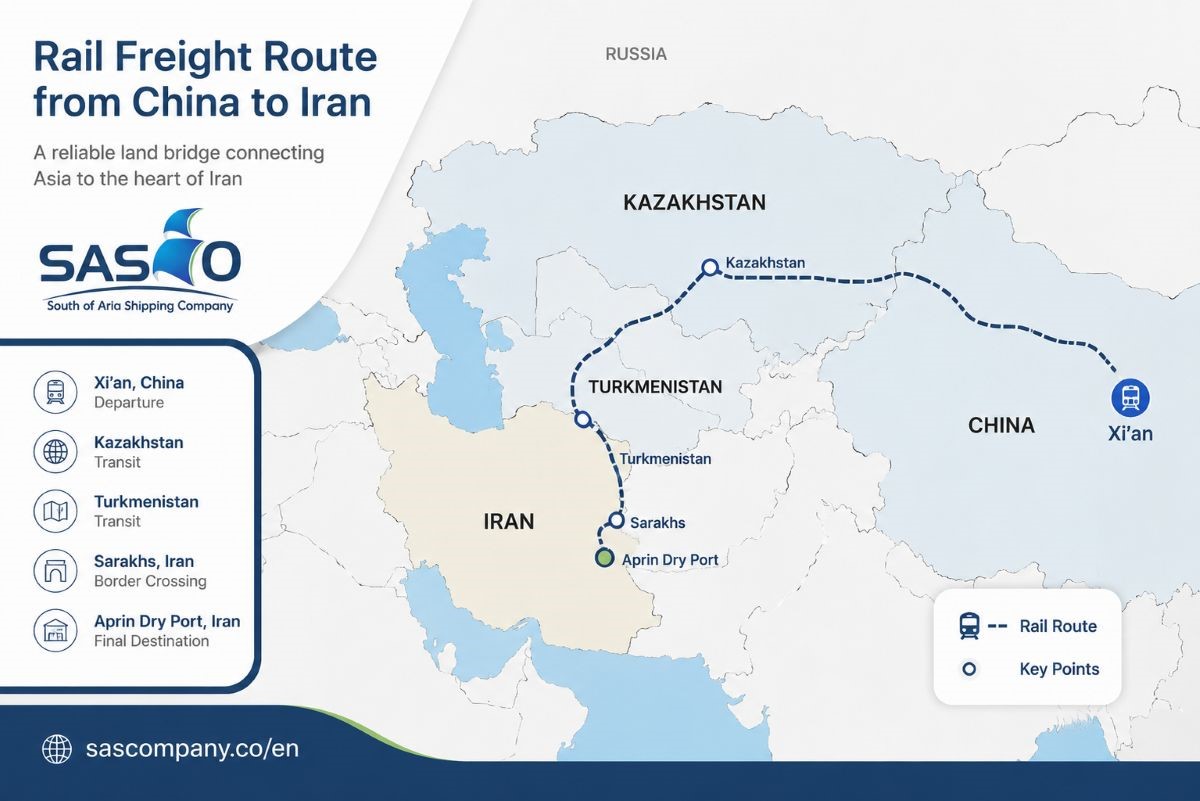
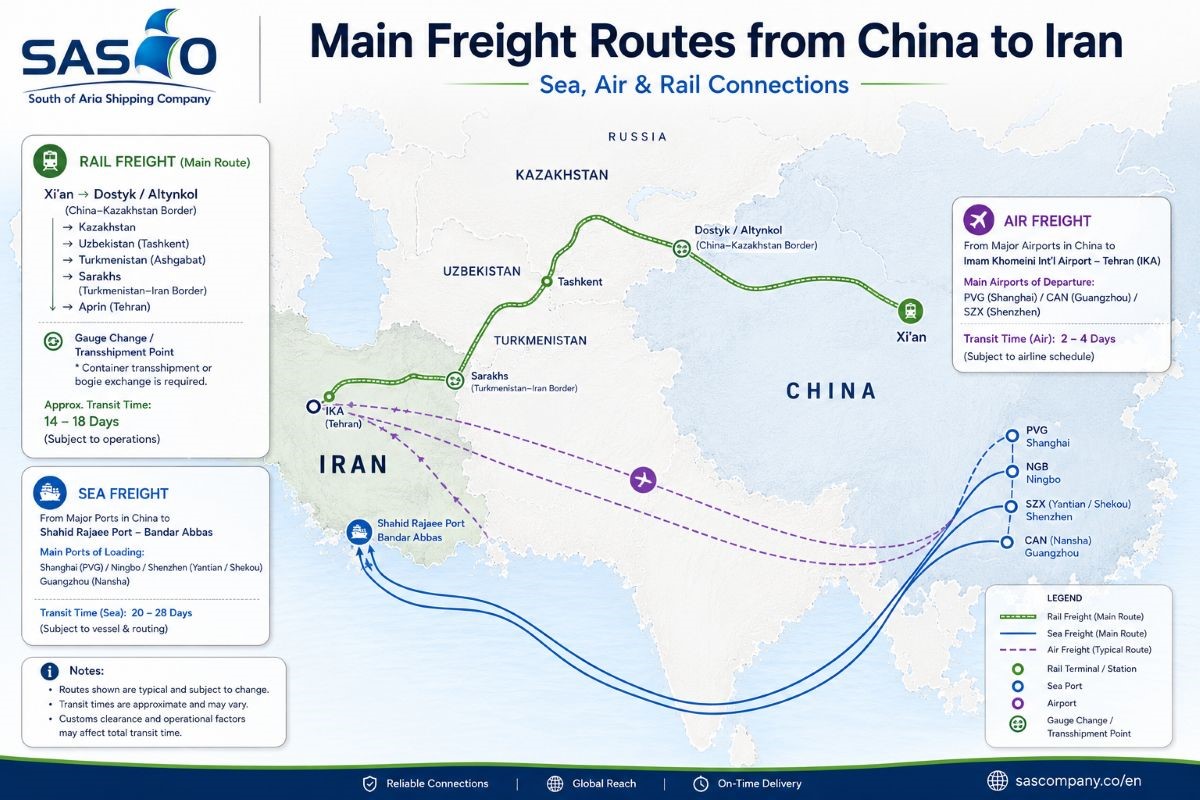
Illustrative route. Actual routing, departure terminal and border crossing may vary by operator and service.
Rail Freight from China to Iran
Rail freight from China to Iran can offer a practical middle option between the lower cost of sea freight and the greater speed of air transport. One commonly used route connects Xi’an, or another Chinese rail hub, with Kazakhstan, continues through Turkmenistan, enters Iran through the Sarakhs border crossing and terminates at Aprin Dry Port near Tehran. This route is illustrated in the map above. The actual departure terminal, routing and border arrangements may vary depending on the operator and available service.
SASCO currently arranges rail freight departures from China to Aprin Dry Port approximately every three to four days. The typical transit time from Xi’an is around 15 days, providing importers with a regular and faster alternative to sea freight. Departure dates and equipment availability are confirmed at the time of booking.
Rail freight is particularly suitable for containerized commercial cargo, industrial components, electronics and medium- to high-value goods when air freight is too expensive but sea freight is too slow. For shipments destined for Tehran and nearby industrial or distribution areas, arrival at Aprin Dry Port may also reduce the distance required for final inland delivery.
However, rail freight is not a complete substitute for sea freight. Its suitability depends on scheduled departures, terminal capacity, wagon and container availability, border procedures, rail-gauge changes and cargo acceptance rules. First-mile pickup in China and last-mile delivery in Iran must also be included in the shipment plan.
The total rail freight cost from China to Iran should therefore be assessed together with origin transport, terminal handling, border-related charges and final delivery from Aprin Dry Port or another Iranian terminal. A terminal-to-terminal quotation does not normally include all of these services unless they are specifically listed.
SASCO’s rail freight services in Iran support route planning, documentation, cross-border coordination and first- and last-mile transport.
Sea vs Air vs Rail — Which Option Should You Choose?
Choosing between sea freight, air freight and rail freight from China to Iran is not only a cost decision. It depends on urgency, cargo type, shipment size and supply chain flexibility. The following decision matrix is designed to help importers quickly identify the most suitable option.
|
Cargo profile |
Recommended method |
|
Heavy or bulky, non-urgent cargo |
Sea freight (FCL or LCL) |
|
Urgent spare parts or time-critical items |
Air freight |
|
High-value commercial cargo with moderate deadline |
Rail or air freight |
|
1–15 CBM and flexible delivery timing |
LCL sea freight |
|
15+ CBM or regular bulk shipments |
Compare FCL vs LCL sea freight |
|
Oversized or non-standard machinery |
Flat rack, open top, breakbulk or project cargo |
|
Mixed urgency shipments |
Split shipment (critical parts by air, remaining cargo by sea or rail) |
Cargo exceeding standard container dimensions requires separate equipment and route planning; see our guide to OOG and project cargo handling in Iran.
In practice, many China-to-Iran supply chains use a combination of methods. For example, urgent components may be shipped by air while the bulk cargo moves by sea or rail. This hybrid approach reduces downtime while keeping overall logistics costs under control.
Customs Clearance in Iran for Goods Imported from China
Customs clearance in Iran for goods imported from China is a critical stage that can significantly affect delivery time and total logistics cost. Many China-to-Iran shipping delays begin before departure, when the invoice, HS code, product description, consignee information or import permit is not aligned with Iranian clearance requirements.
Successful clearance depends on accurate documentation, correct classification and compliance with Iranian import regulations.
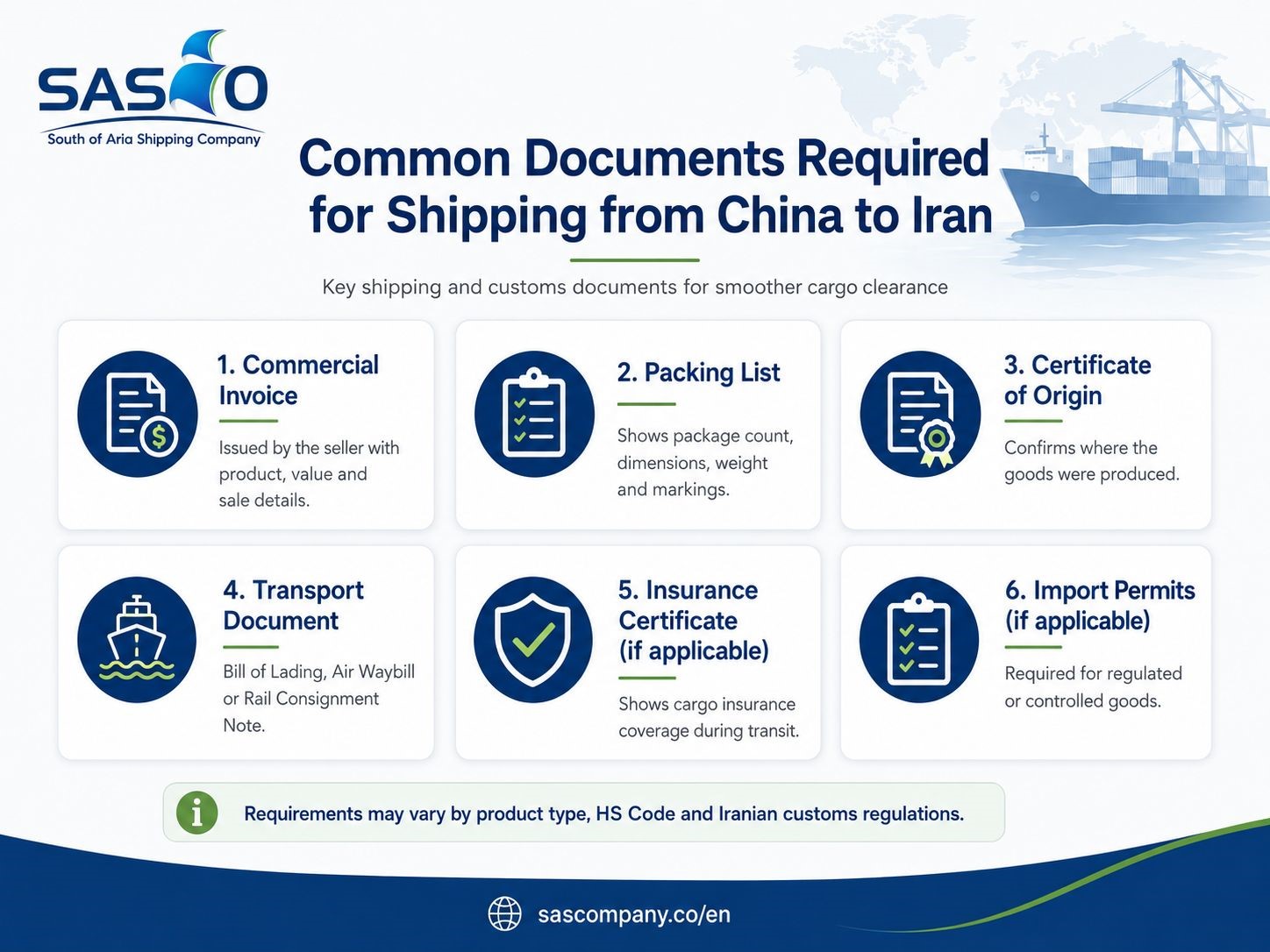
Key documents required for customs clearance
- HS Code classification and review
- Import order registration and import permits (where applicable)
- Importer commercial card (Iran Trade Card)
- Proforma Invoice
- Commercial Invoice
- Packing List
- Certificate of Origin
- Transport document (B/L, Air Waybill or rail consignment note)
- Insurance certificate (if applicable)
For a document-by-document explanation, see our guide to the documents required for shipping to Iran.
Regulatory and control requirements
Depending on the product type, additional approvals may be required from relevant authorities, such as:
- Iran Standard Organization
- Ministry of Health
- or other technical/regulatory bodies for restricted or controlled goods
These approvals are especially important for industrial equipment, food products, medical-related goods and sensitive electronic items.
Pre-shipment coordination
One of the most important factors in reducing delays is aligning documentation before the cargo leaves China. This includes:
- verifying HS code accuracy before shipment
- ensuring invoice description matches physical goods
- confirming consignee details and import registration
- checking permit requirements in advance
Customs process considerations
Customs clearance may involve:
- customs valuation and verification of declared value
- physical inspection of cargo
- potential delays due to documentation mismatch or missing permits
Proper preparation of documents before shipment significantly reduces the risk of storage charges, inspection delays and clearance bottlenecks in Iran.
For importers working with a freight forwarder from China to Iran, early document review and HS classification support can help ensure smoother clearance and faster cargo release.
Best Incoterms for Shipping from China to Iran
The appropriate Incoterm for shipping from China to Iran depends on the transport mode, the buyer’s ability to manage origin operations and the level of control required over freight and customs procedures.
|
Incoterm |
Practical use |
|
EXW – Ex Works |
The buyer manages almost the entire logistics process from the supplier’s factory, including pickup and export arrangements. |
|
FOB – Free on Board |
The seller completes export formalities and delivers the goods on board the vessel at the named Chinese port. It applies only to sea and inland waterway transport. |
|
CFR / CIF |
The seller books and pays for ocean freight to the destination port. Under CIF, the seller also arranges insurance, but destination handling and import clearance still require careful planning. |
|
FCA – Free Carrier |
Often practical for containerized cargo, air freight and rail shipments because delivery can occur at a terminal, warehouse or another named point. |
|
DAP – Delivered at Place |
The seller arranges transport to the named destination, while the buyer normally handles import clearance, duties and taxes. |
|
DDP – Delivered Duty Paid |
The seller assumes the widest delivery responsibility, including import clearance and duties, but only when this is legally and operationally possible in Iran. |
DDP shipping from China to Iran should not be accepted without confirming who will act as the importer, obtain the required permits and complete Iranian customs procedures. The named place must also be stated clearly for every Incoterm.
For a broader explanation of buyer and seller responsibilities, see SASCO’s Incoterms guide.
Step-by-Step Shipping Process from China to Iran
A well-planned shipment should define the responsible party and required documents at every stage.
- Provide cargo details
The importer or supplier provides the product description, quantity, dimensions, gross weight, packaging, pickup address and final destination. - Review the HS Code and import requirements
The importer and customs representative check commodity classification, restrictions, order registration and required permits before booking. - Select the Incoterm
The buyer and seller agree on the named place and determine responsibility for pickup, export clearance, freight, insurance and destination delivery. - Compare sea, air and rail options
The freight forwarder evaluates cost, timing, cargo suitability, routing and available capacity. - Arrange pickup and export clearance in China
The responsible party collects the goods and prepares the commercial invoice, packing list and export documents. - Complete international transportation
The carrier issues the relevant transport document, such as a Bill of Lading, Air Waybill or rail consignment note. - Complete customs clearance in Iran
The importer or appointed customs broker submits the documents, manages permits, valuation and inspection, and arranges cargo release. - Arrange inland delivery
After release, the shipment is transported from the port, airport or rail terminal to the consignee’s final destination.
For China to Iran door-to-door shipping, the quotation should identify which company is responsible for each stage rather than describing the service only as “door-to-door.”
Common Delays and Hidden Costs
Many avoidable China-to-Iran shipping delays begin with incomplete documents or incorrect cargo information. Common causes include:
- inconsistent descriptions across the invoice, packing list and transport document;
- incorrect HS Code classification;
- incomplete order registration or import permits;
- under-declared or inconsistent customs value;
- missing certificates or delayed original documents;
- unsuitable packaging or incorrect cargo labels;
- Chinese New Year capacity constraints;
- port congestion or vessel rescheduling;
- missed transshipment connections;
- limited airline cargo space;
- rail timetable, terminal or border delays.
Hidden costs often arise when the initial quotation does not include destination handling, deconsolidation, delivery order fees, inspection, inland transport or special handling. Storage, demurrage and detention may also apply when documents, permits or cargo release are delayed beyond the available free time.
The most effective way to reduce these risks is to confirm the route, documentation, permits, quotation scope and destination responsibilities before the cargo leaves China.
Before departure, importers can also use our customs-clearance checklist for importing to Iran to identify common documentary and permit-related risks.
Why Work with SASCO for China–Iran Freight?
A freight forwarder from China to Iran should provide more than an international booking. Effective execution also requires destination coordination, document alignment, customs support and delivery planning inside Iran.
SASCO supports China–Iran shipments through:
- Iran-based coordination after cargo arrival;
- operational follow-up at ports, airports and inland terminals;
- pre-shipment document review;
- HS Code and customs documentation support;
- customs-clearance coordination;
- inland delivery planning;
- comparison of sea, air, rail and multimodal options;
- support for standard containers, OOG shipments and project cargo;
- one point of coordination between arrival and final delivery.
This destination-side support can be particularly valuable when the overseas supplier or origin agent is not familiar with Iranian import procedures. The appropriate service is determined according to the cargo, Incoterm, route and consignee requirements rather than applying the same solution to every shipment.
Learn more about SASCO’s freight forwarding services in Iran.
Frequently Asked Questions
How much does shipping from China to Iran cost?
The cost depends on the transport mode, cargo weight or volume, origin, destination, Incoterm and included services. A quotation should distinguish the main freight rate from origin, destination, customs and delivery charges.
How long does shipping from China to Iran take?
Typical planning ranges are approximately 20–45 days by sea, 3–10 working days by air and around 15–20 days by rail. Actual timing depends on the route, schedule, connections, border procedures and service scope.
What is the cheapest way to ship from China to Iran?
Sea freight is normally the lowest-cost option for heavy or large shipments. LCL may suit smaller volumes, while FCL can become more economical as the shipment size increases.
Is air or sea freight better for shipping to Iran?
Air freight is generally better for urgent, lightweight or high-value cargo. Sea freight is usually more economical for heavy, bulky or non-urgent commercial shipments.
Is rail freight from China to Iran currently available?
Rail services are available on selected routes through Central Asia to Iranian terminals. Departure frequency, capacity, cargo acceptance and the current route should be confirmed before booking.
Which Chinese ports ship cargo to Iran?
Common origins include Shanghai, Ningbo, Shenzhen/Yantian, Guangzhou/Nansha, Qingdao, Tianjin and Xiamen. The most suitable port depends on the supplier’s location, carrier schedule and Iranian destination.
Which Iranian port is best for cargo from China?
Bandar Abbas is normally the principal option for containerized imports, but Chabahar, Bushehr or Bandar Imam Khomeini may suit particular routes and cargo types.
What documents are required for shipping from China to Iran?
Documents required for shipping from China to Iran commonly include the commercial invoice, packing list, Certificate of Origin, transport document, insurance certificate and relevant import permits. Requirements vary by product and HS Code.
Can I arrange door-to-door shipping from China to Iran?
Yes, but the quotation must define whether pickup, export clearance, international freight, import clearance, duties and final delivery are included. The Incoterm and importer responsibilities should also be confirmed.
Does the quoted transit time include customs clearance?
Not necessarily. Port-to-port, airport-to-airport and terminal-to-terminal estimates normally cover only the main transport leg. Customs clearance, handling and inland delivery can extend the total delivery time.
What affects the 20ft container shipping cost from China to Iran?
The 20ft container shipping cost from China to Iran depends on the Chinese port, Iranian destination, carrier, route, cargo weight, season and included origin and destination charges.
What affects the 40ft container shipping cost from China to Iran?
The 40ft container shipping cost from China to Iran depends on the selected 40GP or 40HC equipment, route, carrier capacity, quotation date and service scope.
How do I choose the best freight forwarder for shipping from China to Iran?
The best freight forwarder for shipping from China to Iran should provide transparent quotations, document review, route comparison, destination coordination, customs support and clear responsibility from arrival to final delivery.