

Customs Clearance Checklist for Importing to Iran at a Glance
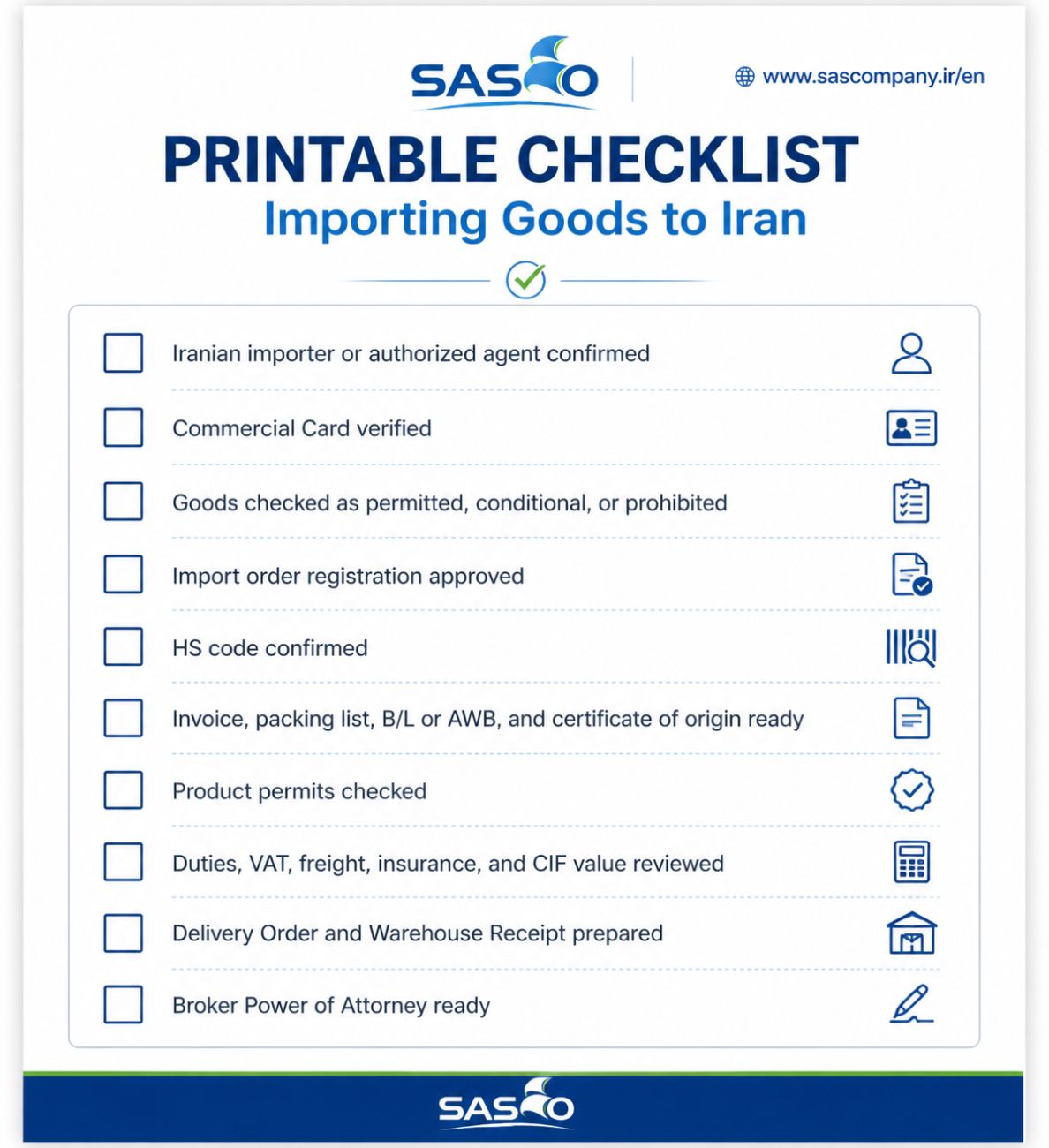
Before shipping goods to Iran, importers should make sure that the shipment is ready from a customs, documentation, and compliance perspective. The checklist below summarizes the main items that should be reviewed before the cargo reaches Iranian customs.
|
Checklist Item |
What to Confirm Before Importing to Iran |
|
Importer readiness |
The Iranian importer, authorized agent, or customs broker is confirmed. |
|
Commercial Card |
The importer has the required Commercial Card for commercial import activity. |
|
Product status |
The goods are checked as permissible, conditional, or prohibited. |
|
Import order registration |
The import order registration is completed before shipment. |
|
Core documents |
Commercial invoice, packing list, B/L or AWB, and certificate of origin are ready. |
|
Product permits |
Required health, standard, sanitary, or technical approvals are checked. |
|
HS code |
The HS code matches the product description and regulatory requirements. |
|
Customs value |
Invoice value, Incoterms, freight, and insurance details are consistent. |
|
Labeling and packaging |
Persian labeling and packaging requirements are reviewed where applicable. |
|
Arrival documents |
Delivery order, warehouse receipt, and broker authorization are prepared. |
This checklist gives importers a practical overview. The following sections explain each part in more detail.
Pre-Shipment Checklist for Importing Goods to Iran
Before shipping cargo, importers should complete the key pre-shipment checks that affect customs clearance for imports to Iran. At this stage, the goal is simple: confirm that the importer, product status, permits, and import order registration are ready before the goods leave the origin country.
Confirm the Iranian Importer or Authorized Agent
Foreign exporters usually need to coordinate with an Iranian importer or authorized agent before importing goods to Iran. For commercial import activity, the Iranian side must normally hold a valid Commercial Card, issued through the Iranian Chamber system and approved by the relevant authority. This matters because customs documents, import registration, payment arrangements, and final clearance are usually handled through the Iranian importer or their appointed customs broker. To streamline international shipping, some exporters use the services of a reliable freight forwarder.
Check Whether the Goods Are Permitted, Conditional, or Prohibited
A strong Iran customs clearance checklist should start with product eligibility. Before shipment, confirm whether the goods are freely importable, require a prior permit, or are prohibited. Conditional goods may need approval from a relevant authority, such as health, agriculture, industry, or standards bodies. Importers should also check whether origin-country restrictions, sanctions exposure, or product-specific controls may affect the transaction. Iran’s export-import framework classifies goods into permitted, conditional, and prohibited categories.
Complete Import Order Registration Before Shipment
Import order registration should be completed before the cargo is dispatched. The approved import order connects the importer, product description, HS code, origin, value, and payment method to the official import file. Article 8 of Iran’s Export-Import Regulations Act refers to licensing imports and registration of orders, and Iran’s official foreign exporter guidance states that an approved Import Order is mandatory for customs clearance.
Required Documents Checklist for Iran Customs Clearance
Preparing the right documents is one of the most important parts of any Iran import documents checklist. Some documents must be ready before shipment, while others are issued after cargo departure or after the goods arrive at an Iranian customs warehouse. The key point is that the importer and customs broker should know which documents are needed at each stage and make sure all information remains consistent across the shipment file.
|
Document |
When Needed |
What to Check |
|
Commercial Invoice |
Before shipment / before declaration |
Confirms the seller, buyer, product description, quantity, unit price, total value, currency, and Incoterms. |
|
Packing List |
Before shipment / before declaration |
Shows package count, gross and net weight, dimensions, and how the goods are packed. |
|
Bill of Lading / Air Waybill |
After cargo handover to carrier |
Links the shipment to the carrier, origin, destination, consignee, and cargo movement. For more details, see our guide to bill of lading in Iran. |
|
Certificate of Origin |
Before declaration |
Confirms where the goods were produced or manufactured and supports origin-related customs checks. |
|
Insurance Certificate |
If applicable, before valuation/declaration |
Required where insurance is part of the shipment value or commercial arrangement. |
|
Approved Import Order |
Before shipment / before clearance |
Shows that the import file has been registered and approved before clearance. |
|
Delivery Order |
After arrival |
Issued by the carrier or shipping line to release the cargo to the consignee or broker. |
|
Warehouse Receipt |
After arrival at customs warehouse |
Confirms that the goods have entered the customs warehouse and can be declared. |
|
Certificate of Inspection |
If required, often before shipment |
Required for some goods, especially where inspection at origin is requested. |
|
Certificate of Conformity |
If required, before clearance |
Required when goods are subject to mandatory Iranian standards. |
|
Health, sanitary, phytosanitary, or safety documents |
Depending on product type |
Needed depending on the product type, such as food, cosmetics, agricultural goods, chemicals, or medical items. |
A useful rule is simple: every document should describe the same goods in the same way. The product name, HS code, quantity, weight, value, origin, and consignee details should match across the shipment file before the customs declaration is submitted.
Product Compliance, Permits, and Standards Checklist
Before checking standards or health permits, confirm the product’s legal import status. Under Iran’s Export-Import Regulations Act, importable and exportable goods are classified as permissible, conditional, or prohibited. Importers should review permitted, conditional, or prohibited goods under Iran’s Export-Import Regulations Act and then check the latest Iran Export-Import Regulations Book for product-specific rules, tariffs, and permit requirements.
Industrial products may also be subject to Iranian national standards or accepted international standards. Importers should review the list of imported goods subject to mandatory INSO standards and confirm whether the product needs a Certificate of Conformity before customs clearance.
Check if the Product Needs a Conformity Certificate
For goods covered by mandatory standards, the importer should review INSO mandatory standards and conformity requirements for imports before shipping. Some products may also require a Certificate of Inspection at origin, especially where testing is not possible or takes a long time after arrival.
Check if Health, Safety, or Sanitary Permits Apply
Food, pharmaceuticals, cosmetics, agricultural goods, animal products, chemicals, and medical items may need product-specific approvals. For plant-based or agricultural goods, check Iran Plant Protection Organization import quarantine conditions. For livestock, animal products, and aquatic goods, check Iran Veterinary Organization import and health clearance permits.
Check Labeling and Packaging Before Shipment
Some imported goods may require Persian labeling, Persian or English manuals, safety warnings, or product marking depending on the product category and applicable Iranian standards.
HS Code, Customs Value, Duties, and VAT Checklist
The HS code should be confirmed before order registration and customs declaration. It affects the tariff rate, required permits, mandatory standards, and sometimes the inspection risk of the shipment. Because the Harmonized System is the international basis for classifying traded goods, the selected code should match the product description, material, function, and technical specifications.
Importers should also check that the invoice value, Incoterms, freight, insurance, and country of origin are consistent across all documents. Customs value is generally linked to the CIF value, so unclear freight or insurance details can affect duties and taxes.
Before shipment or declaration, confirm current duties, commercial profit, VAT, and related charges through a licensed customs broker, the Iran Comprehensive Trade System / NTSW, or the latest Iran Export-Import Regulations Book. Do not rely on old rates, because tariff lines, VAT treatment, and import requirements may change.
Arrival, Warehouse, and Customs Declaration Checklist
After the goods arrive in Iran, the importer or broker should collect the Delivery Order from the carrier and confirm that the cargo has entered the customs warehouse. The Warehouse Receipt is then used as one of the key documents for declaration.
If a customs broker handles the process, the Power of Attorney should be ready before filing. The declaration is submitted through the Iran Customs EPL portal, where shipment data and supporting documents are entered, the declaration path is assigned, and payment details are generated. Iran trade guidance describes this flow through warehouse receipt, power of attorney, online EPL declaration, route determination, customs permit issuance, and final exit from customs.
Final Customs Clearance Checklist for Importers
Use this final Iran customs clearance checklist before the shipment reaches the main clearance stage. It helps importers quickly confirm whether the cargo, documents, permits, and customs data are ready for declaration and release.
|
Stage |
What to Check |
|
Importer readiness |
Commercial Card, Iranian importer, authorized agent, or customs broker |
|
Product eligibility |
Goods are confirmed as permitted, conditional, or prohibited |
|
Order registration |
Import order registration is approved before shipment |
|
Documents |
Commercial invoice, packing list, B/L or AWB, and certificate of origin |
|
Compliance |
INSO standards, health, sanitary, safety, or conformity requirements |
|
Value and HS code |
Correct HS classification, declared value, Incoterms, freight, and insurance |
|
Arrival |
Delivery Order and Warehouse Receipt are available |
|
Declaration |
EPL filing, duties, payment details, and customs permit are handled |
|
Release |
Exit authorization and final delivery are arranged |
The most important rule is consistency. The product description, HS code, quantity, value, origin, and consignee details should match across all documents before the customs declaration is submitted.
Common Mistakes This Checklist Helps Prevent
A practical checklist helps importers catch clearance risks before cargo reaches Iran. Many delays happen because small document, permit, or value details are missed during pre-shipment planning. Use this section to review the most common problems:
- Shipping before import order registration is approved
- Using an incorrect HS code
- Mismatch between invoice, packing list, and B/L
- Missing certificate of origin
- Ignoring INSO or health permit requirements
- Unclear freight, insurance, or Incoterms information
Checking these items early helps reduce customs questions, storage charges, correction requests, and avoidable release delays at Iranian customs.
Conclusion
A successful import process starts before the cargo reaches Iranian customs. By checking importer readiness, order registration, documents, HS code, permits, standards, valuation, and arrival paperwork in advance, importers can reduce delays and avoid unnecessary costs. Before your cargo is shipped to Iran, SASCO can help review your customs documents, import requirements, and clearance risks so the process starts with fewer surprises.
FAQ
What documents are required for importing goods to Iran?
The main documents usually include a commercial invoice, packing list, Bill of Lading or Air Waybill, certificate of origin, approved import order, and product-specific permits where required.
Do I need import order registration before shipping to Iran?
Yes. For commercial imports, import order registration should normally be approved before shipment. It connects the importer, goods, HS code, origin, value, and payment details to the official import file.
Do all goods imported to Iran need a conformity certificate?
No. A Certificate of Conformity is usually required only for goods subject to mandatory Iranian standards or specific regulatory controls. Importers should check this before shipping.
What causes customs clearance delays in Iran?
Common causes include missing documents, wrong HS codes, invoice and packing list mismatches, incomplete import order registration, missing permits, unclear customs value, and non-compliant labeling.
Do foreign exporters need an Iranian importer or agent?
In most commercial shipments, foreign exporters work with an Iranian importer, authorized agent, or customs broker. The Iranian side usually handles import registration, customs declaration, and release procedures.