

What Customs Clearance Means for Shipping from Iran to Australia
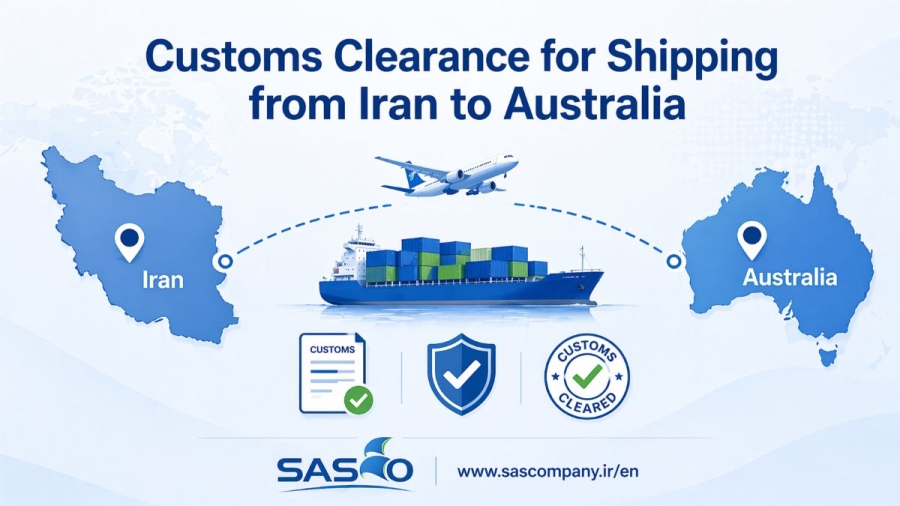
Customs clearance is the process of declaring imported goods to Australian authorities so they can be assessed for duty, tax, restrictions, and border requirements before release. In Australia, this stage is especially sensitive because it may involve not only customs assessment, but also biosecurity review, permit checks, and closer scrutiny of cargo descriptions, packaging, or regulated goods. Just as importantly, cargo arrival is not the same as cargo release. A shipment may reach an Australian port or airport, but it is not released until the correct declaration has been lodged and any applicable clearance conditions have been satisfied.
Which Australian Authorities Are Involved in Customs Clearance?
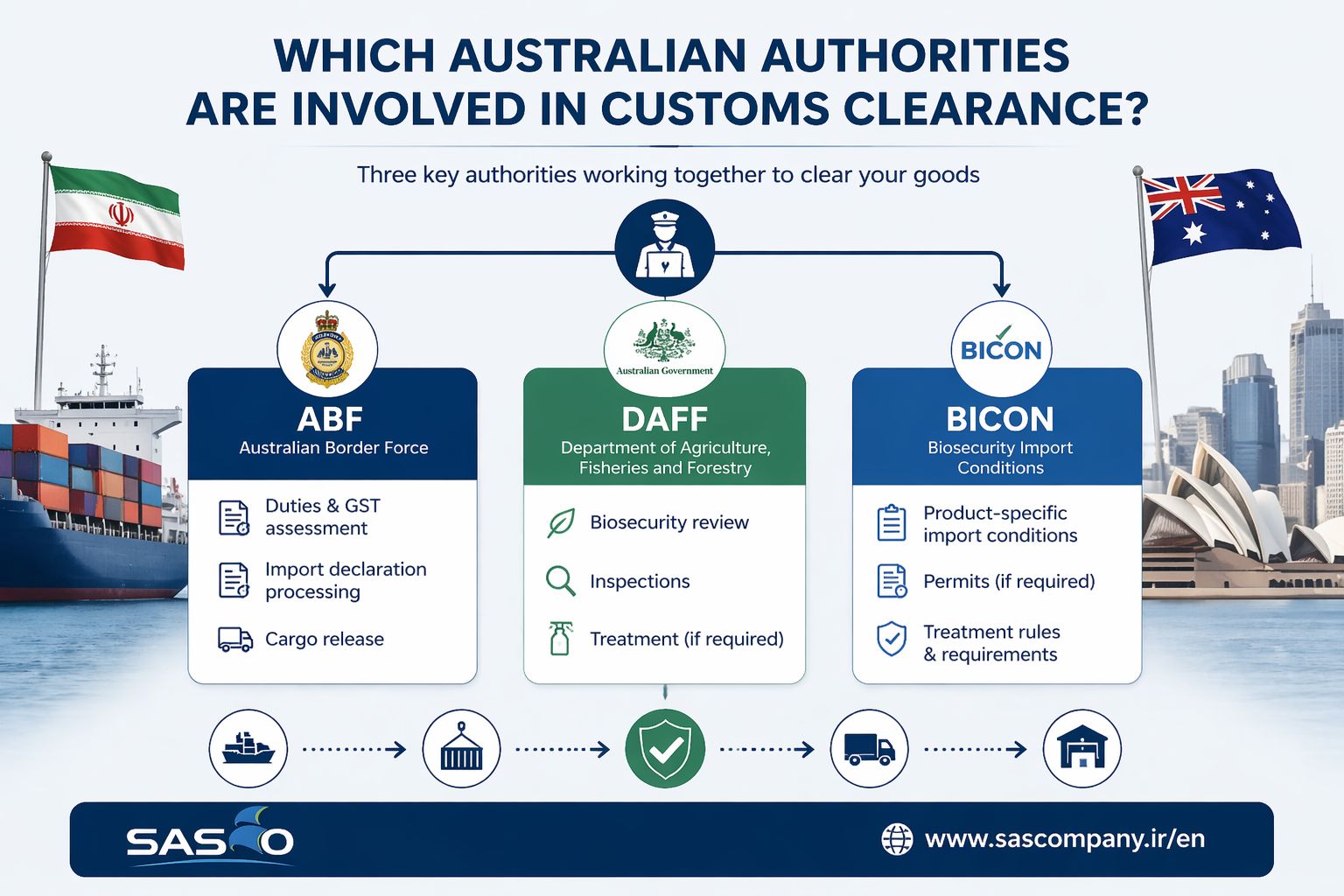
Australian Border Force (ABF)
For customs clearance for shipping from Iran to Australia, the Australian Border Force (ABF) is the main authority responsible for import declarations, customs control, duties, GST, and cargo release. In practice, ABF assesses whether the shipment has been declared correctly and whether it can move beyond customs control.
DAFF and biosecurity review
Clearance in Australia is not handled by customs alone. The Department of Agriculture, Fisheries and Forestry (DAFF) becomes involved where goods raise biosecurity concerns. Depending on the cargo or packaging, goods may be referred for inspection, treatment, or supporting documentation. This is why Australian customs and biosecurity clearance should be treated as one connected process.
BICON and product-specific import conditions
BICON is the main system used to check whether a product is permitted into Australia, whether conditions apply, and whether treatment, supporting documents, or a permit may be required. For that reason, BICON should be checked before shipment, especially for food, plant-based goods, timber, bamboo, and other higher-risk cargo.
Import Declaration vs SAC: What Changes at AUD 1,000?
An Import Declaration is the fuller declaration path generally used for higher-value goods, while a Self-Assessed Clearance (SAC) declaration is a simplified pathway that may apply to lower-value consignments. This distinction matters because it affects how goods are reported, assessed, and released in Australia.
When an Import Declaration is required
In general, goods imported by sea, air, or post with a value above AUD 1,000 are cleared through an Import Declaration, and relevant duties, taxes, and charges may apply. This path involves fuller reporting and closer assessment.
When a SAC declaration may apply
If imported goods arrive by air or sea cargo and have a value of AUD 1,000 or less, a Self-Assessed Clearance declaration (SAC) may apply instead. Lower-value cargo can often move through this lighter declaration path. However, SAC does not apply to international mail, and goods that require a permit may need an Import Declaration or a long-format SAC rather than the simplest pathway.
Why low-value and high-value shipments follow different paths
Low-value and high-value shipments follow different paths because they do not present the same customs and processing profile. Lower-value cargo may qualify for simplified reporting, while higher-value goods usually require fuller assessment before cargo release in Australia can take place.
|
SAC |
Import Declaration |
|
Usually AUD 1,000 or less |
Usually above AUD 1,000 |
|
Simplified pathway |
Fuller declaration |
|
Less data |
More detailed reporting |
|
Lower-risk shipments |
Higher-value / more assessed |
Documents That Support Customs Clearance
For customs clearance for shipping from Iran to Australia, the key issue is not every document in the shipment file, but the records that directly support declaration, assessment, and release. For a full checklist, see our guide to required documents for shipping from Iran to Australia.
1.Commercial invoice and cargo description
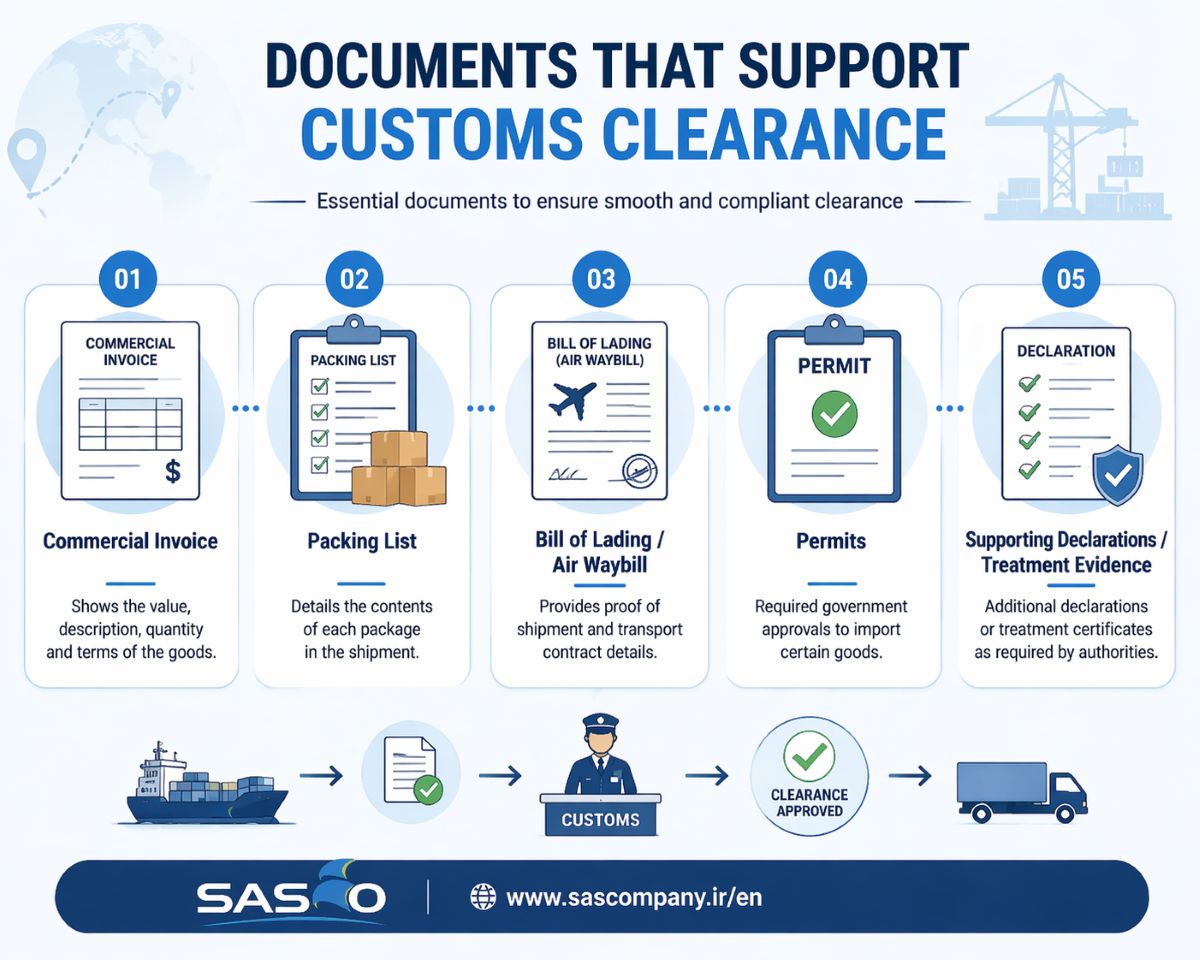
The commercial invoice supports Iran to Australia customs clearance by showing the declared value, the parties involved, and the commercial basis of the shipment. The cargo description is equally important. If it is vague or inconsistent, customs assessment can slow down and release may be delayed.
2.Packing list and transport document
The packing list helps authorities verify how the goods are packed, counted, and weighed. The transport document — usually a Bill of Lading or Air Waybill — links the shipment to its movement details, consignee information, and arrival record. Together, these documents support declaration and make release smoother.
3.Supporting declarations and permits where required
Some goods also need supporting declarations, treatment evidence, or product-specific permits. This is especially relevant where biosecurity risk, restricted imports, or commodity-specific controls apply. In these cases, the supporting paperwork helps show that the goods meet the conditions for Australian customs and biosecurity clearance.
Duties, GST, and Import Processing Charges
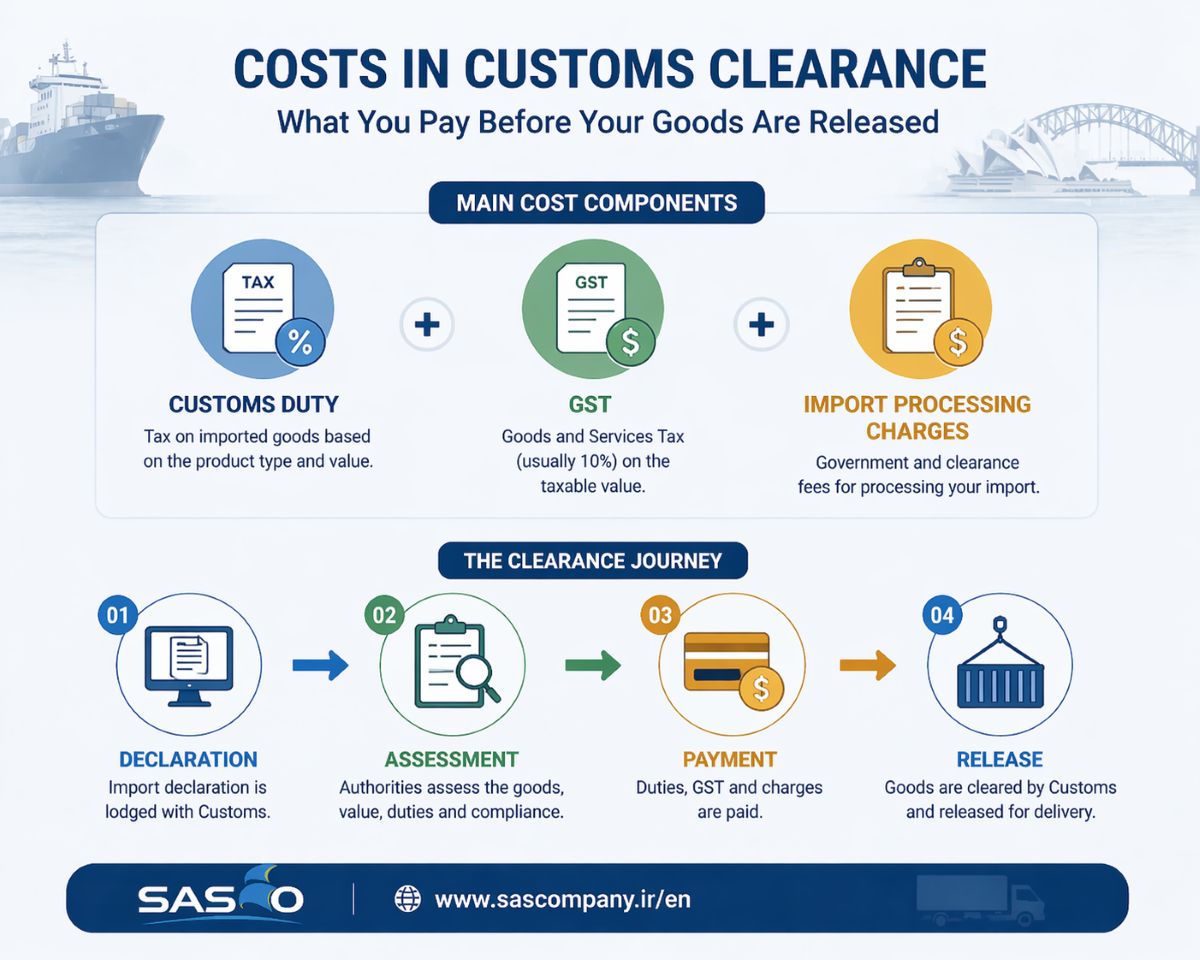
In customs clearance for shipping from Iran to Australia, declaration is only one part of the process. Clearance can also involve customs duty, GST, import processing charges, and, in some cases, biosecurity cost recovery charges. This matters because cargo release in Australia may depend on both correct reporting and payment of applicable charges.
Customs duty
Customs duty is one of the main financial elements of import clearance. ABF states that goods valued above AUD 1,000, as well as some goods such as alcohol and tobacco, may be subject to duty and other charges. This makes customs value and product classification part of the clearance process, not just pricing.
GST on imports
GST also forms part of the import clearance framework unless an exemption applies. For goods valued at AUD 1,000 or less, duty and GST are generally not payable under the short-format SAC pathway, except for tobacco and alcoholic products. This is why import declaration vs SAC Australia affects more than paperwork alone.
Import processing and related charges
ABF also applies import processing charges when a declaration is lodged. The amount depends on factors such as declaration type, consignment value, cargo channel, and lodgement method. The key point here is simple: declaration, assessment, and release can all involve formal charges as part of the import process.
Biosecurity Checks and BICON Requirements
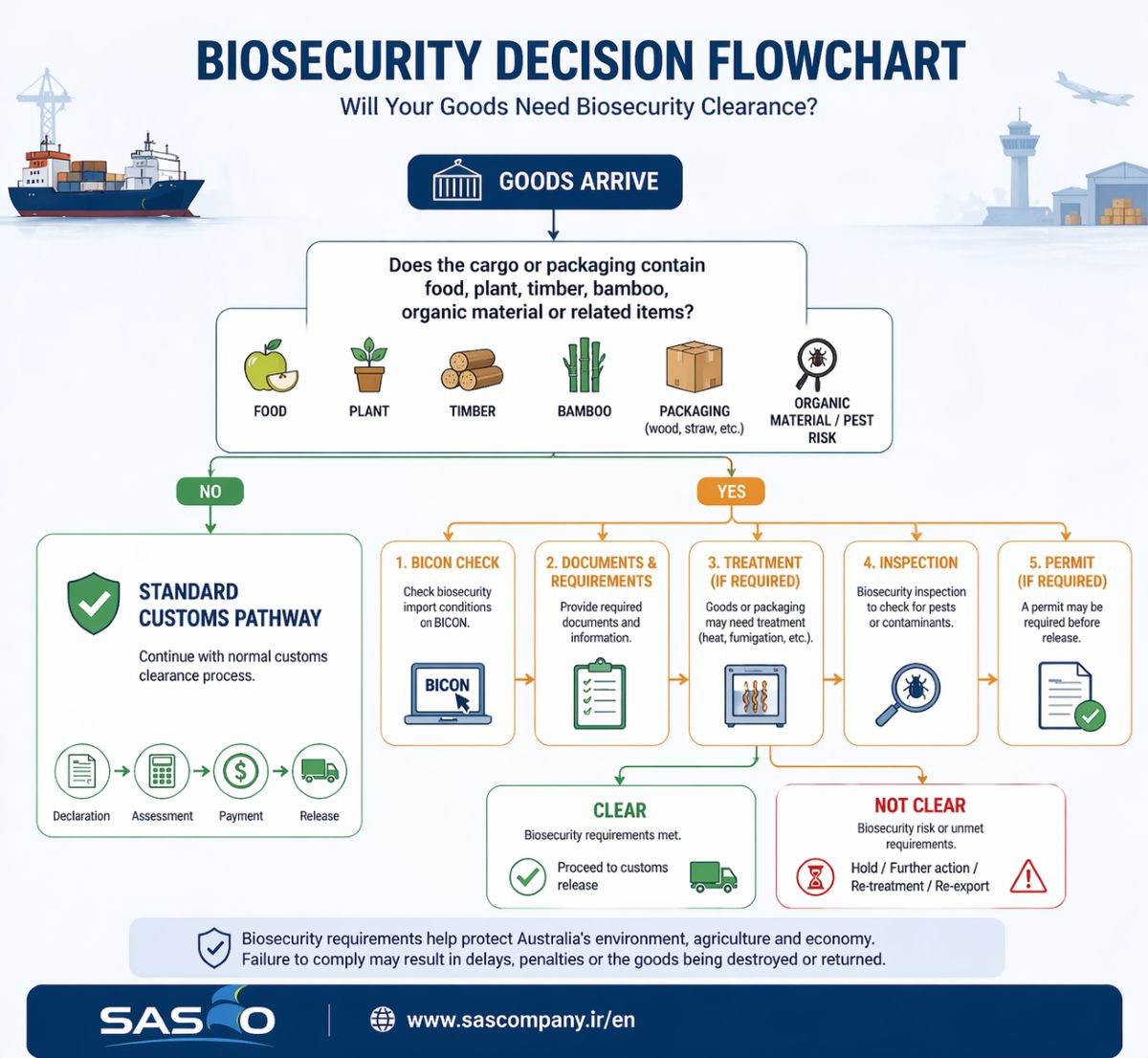
For customs clearance for shipping from Iran to Australia, biosecurity is not a side issue. Australian authorities may review goods more closely when the cargo, packaging, or product type presents a plant, animal, food, timber, bamboo, or contamination risk. In practice, a shipment can clear the customs declaration side and still be delayed if biosecurity conditions have not been satisfied.
When biosecurity review is triggered?
Biosecurity review is more likely when goods contain organic materials, food ingredients, plant-based products, untreated timber, bamboo, soil contamination, or other materials that may carry pests or disease. This is why Australian customs and biosecurity clearance should be treated as one connected process rather than two separate checkpoints.
Food, plant, timber, bamboo, and agricultural risk items
Higher-risk categories include food, plant products, agricultural goods, and timber or bamboo items. Australia’s BICON system is the main tool for checking whether these goods are allowed, what conditions apply, and whether inspection, treatment, or a permit may be required before release.
Packaging declarations and treatment evidence
Packaging can also trigger review. A packing declaration may need to confirm container cleanliness and whether straw, timber, or bamboo has been used as packing material. Where relevant, timber or bamboo packaging must be declared, and treatment evidence may be needed to show that the packaging meets Australian biosecurity conditions.
When an import permit may be required
Some goods do not need a permit, but others do. The key point is that permit requirements depend on the product and its biosecurity pathway, not simply on the fact that it is being imported. For that reason, BICON should be checked before dispatch, not after arrival. If a permit-required product arrives without one, release may be refused and the goods may need to be re-exported or destroyed.
Prohibited and Restricted Goods
Another important part of customs clearance for shipping from Iran to Australia is understanding that not all goods follow the same import rules. Australia does not require a general import licence for all goods, but that does not mean all goods are freely importable.
- Goods that cannot be imported: Some goods are under absolute prohibition, which means they must not be imported in any circumstance.
- Goods that may need permission or a permit: Other goods are restricted rather than absolutely banned. ABF states that many prohibited goods may still be imported with written permission if the relevant conditions and requirements are met.
Why “no general import licence” does not mean “no restrictions”
This distinction matters because importers sometimes assume that if Australia does not require a general import licence, no special approval is needed. In reality, cargo release in Australia can still be blocked where restricted goods require written permission, a permit, or product-specific compliance before they can lawfully enter.
Before shipment, importers should check both the ABF prohibited goods list and BICON to confirm whether the product is banned, restricted, or subject to permit conditions.
Common Reasons Shipments Get Delayed at Clearance
In customs clearance for shipping from Iran to Australia, delays usually happen when the shipment file, the declared data, and the actual goods do not align. In practice, the problem is often not that the cargo has arrived late, but that Australian authorities still need enough clarity to assess, refer, or release it.
Incorrect or vague cargo descriptions
A generic description such as “goods,” “food items,” or “wood products” can slow assessment because it does not clearly show what is being imported or what conditions may apply. The more precise the description, the easier it is for border authorities to assess the declaration and decide whether extra review is needed.
HS code or value mismatch
Clearance can also slow down when the tariff classification or declared value does not match the goods. This matters even more around the AUD 1,000 threshold, because low-value cargo may move through a SAC pathway while higher-value goods require a fuller import declaration. If the declaration path does not match the shipment, review and correction can follow.
Missing permit or supporting document
Some goods need more than standard commercial paperwork. If a permit, treatment statement, or other supporting document is required but missing, release can stop until the importer satisfies that condition. This is especially relevant where product-specific import controls apply.
Biosecurity concerns with packaging or contents
Biosecurity holds are another common source of delay. Food, plant-based goods, and timber or bamboo packaging can trigger extra review, especially where packing declarations, cleanliness statements, or treatment evidence are incomplete.
Shipment arrives, but release conditions are not yet satisfied
A final and very common point of confusion is that arrival does not mean release. Goods can physically reach Australia and still remain under customs control until the correct declaration has been lodged and any duty, GST, permit, or biosecurity conditions have been satisfied. This is why cargo release in Australia depends on clearance completion, not only on transport completion.
Step-by-Step Customs Clearance Process for Shipments to Australia
For Iran to Australia customs clearance, the process is best understood as a sequence:
- Pre-shipment review: Use an import & export consulting service to check product conditions, declaration pathway, and any BICON-related requirements before dispatch.
- Cargo departure:The goods leave Iran with the commercial and transport file prepared, and importers may also arrange a cargo insurance service to reduce transport-related risk exposure.
- Arrival in Australia: The shipment reaches the port, airport, or cargo terminal but is not yet released.
- Declaration lodgement: The importer or broker lodges the correct Import Declaration or SAC, depending on the shipment.
- Assessment: Australian authorities assess duty, GST, and any relevant import or biosecurity conditions.
- Inspection or biosecurity review: If required, the goods or packaging may be referred for further checks.
- Final cargo release: The shipment is released only after declaration requirements and any applicable conditions have been satisfied.
Do You Need a Customs Broker?
Not every shipment requires a broker, but broker support is often helpful in customs clearance for shipping from Iran to Australia when the goods require a full Import Declaration, involve border charges, or may trigger permit or biosecurity review.
When broker support is helpful
Broker support is most useful when the declaration path is unclear, the cargo is commercial or higher-value, or mistakes in value, classification, or supporting documents could delay release.
Higher-value cargo, complex goods, and biosecurity-sensitive shipments
For higher-value, complex, or biosecurity-sensitive shipments, professional support can make clearance smoother and reduce avoidable delays. If you want extra confidence before dispatch, SASCO’s customs clearance service can help review your shipment file and support a more prepared clearance process.
FAQ
Do all shipments from Iran to Australia need customs clearance?
All imported goods are subject to Australian border control, but the declaration path depends on shipment type and value.
What is the difference between cargo arrival and cargo release?
Arrival means the goods have reached Australia. Release happens only after the correct declaration and any applicable conditions have been completed.
When do I need an Import Declaration instead of a SAC?
In general, goods above AUD 1,000 follow the fuller Import Declaration path, while eligible low-value air or sea cargo may use a SAC declaration.
Do all goods need an import permit in Australia?
No. Australia does not require a general import licence for all goods, but some goods are prohibited, restricted, or subject to product-specific permission.
What usually causes customs clearance delays?
Common causes include vague cargo descriptions, HS code or value mismatches, missing permits, and unresolved biosecurity checks.
How do biosecurity checks affect release?
If goods or packaging raise biosecurity concerns, release may be delayed until the required checks, documents, or treatments are completed.