

What Is Heavy Equipment Transport in Iran?
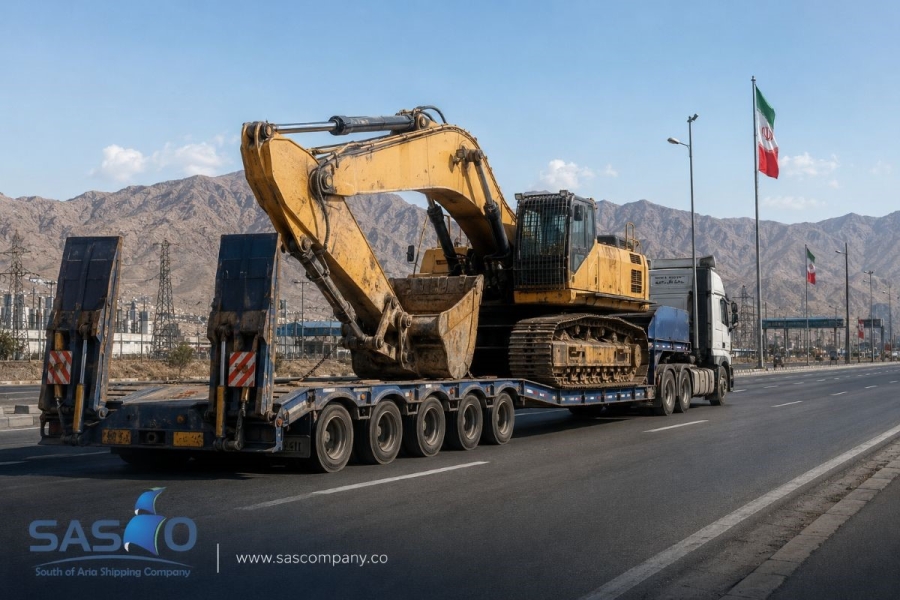
Heavy equipment transport in Iran is the specialized road movement of construction, mining and industrial machinery that cannot always be carried using standard trucks or trailers. Typical examples include excavators, bulldozers, wheel loaders, motor graders, road rollers, drilling rigs, mobile cranes and large mining machinery.
The transport method is determined by the machine’s shipping configuration, not simply by its operating weight. Overall length, width, loaded height, gross transport weight, center of gravity and axle or track arrangement all influence trailer selection and route feasibility.
For example, a large excavator may require a low-bed trailer because of its height and weight. Removing the bucket, boom or counterweight may reduce the transport envelope or improve load distribution. As a result, construction equipment transport in Iran should be planned using the dimensions and weight of the machine in its actual transport condition.
Heavy Equipment vs. OOG Cargo vs. Heavy Lift vs. Project Cargo
These terms frequently overlap in industrial logistics, but they describe different characteristics of a shipment.
Heavy Equipment refers to the machinery itself. Excavators, bulldozers, loaders, drilling rigs and mobile cranes are heavy equipment because of their function and physical characteristics. A machine can therefore be classified as heavy equipment without necessarily being OOG or heavy lift.
Out-of-Gauge (OOG) Cargo is primarily a dimensional classification. If a machine exceeds the dimensional limits of standard container equipment, it may require flat-rack, open-top or another specialized solution. A large excavator can therefore be both heavy equipment and OOG cargo. SASCO's OOG cargo handling in Iran covers shipments that exceed standard container dimensions.
Heavy Lift is driven more by weight and handling engineering than by the type of cargo. A transformer, reactor or 200-ton industrial column may require engineered lifting plans because of its unit weight, center of gravity or lifting geometry, even though it would not normally be described as heavy equipment. These operations fall within heavy-lift cargo transportation through Iran.
Project Cargo describes the wider logistics operation rather than one physical property of the shipment. A project may combine heavy machinery, oversized components and other non-standard units that require coordinated port handling, inland transport, route planning, lifting and site delivery. Heavy equipment can therefore form part of a project cargo and OOG transport operation in Iran, but moving one excavator does not automatically make the shipment project cargo.
In practical terms, a mining excavator may be heavy equipment and OOG cargo at the same time, while a large refinery column may be heavy lift and project cargo without being heavy equipment. Identifying the correct category helps determine the required trailer, handling method, route assessment and level of transport engineering.
Types of Heavy Equipment Transported in Iran
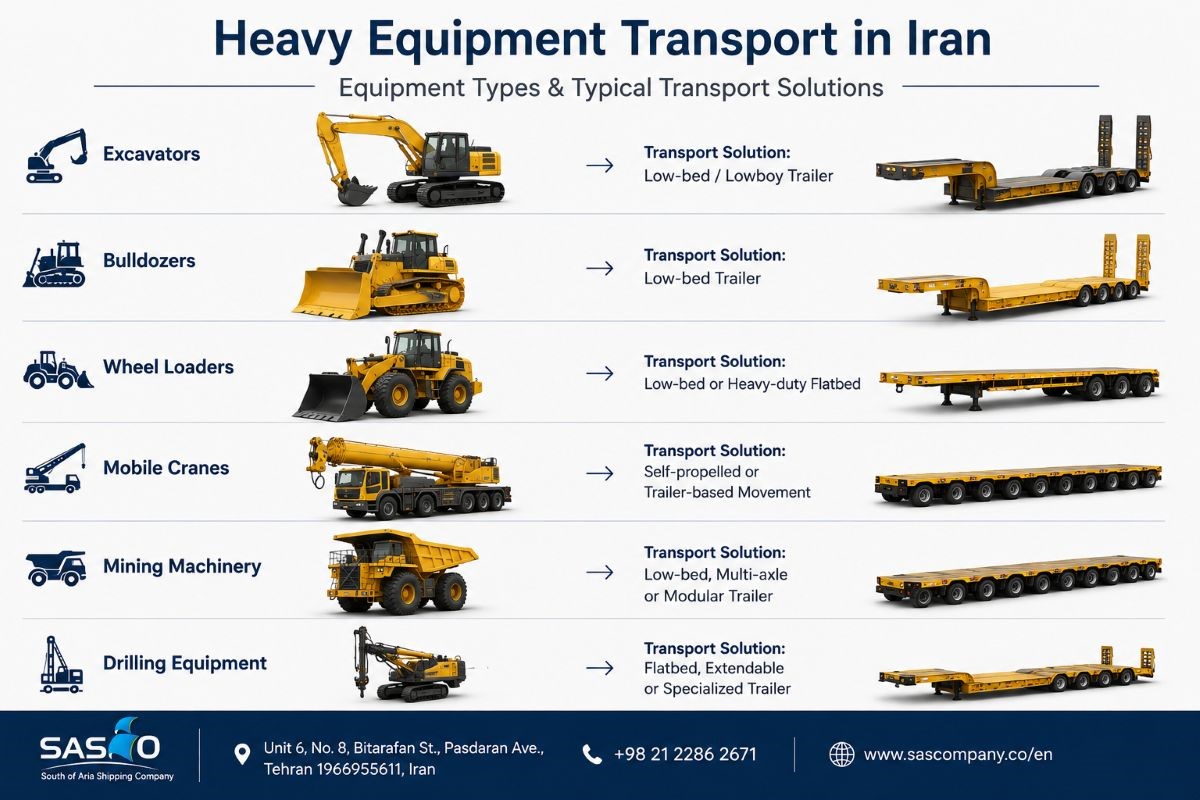
Heavy equipment transported across Iran includes construction machinery, mining equipment, drilling units and industrial machines that may require specialized road transport. Instead of assigning one trailer type to an entire equipment category, the transport solution should reflect the machine’s loaded profile and the conditions at origin and destination.
|
Equipment |
Typical Transport Solution |
Main Planning Consideration |
|
Excavators |
Low-bed / lowboy trailer |
Loaded height, track width, boom and bucket position |
|
Bulldozers |
Low-bed trailer |
Blade or ripper dimensions and transport weight |
|
Wheel loaders |
Low-bed or heavy-duty flatbed |
Overall height, axle load and loading access |
|
Mobile cranes |
Self-propelled or trailer-based movement, depending on configuration |
Axle loads, boom configuration, counterweights and road requirements |
|
Mining machinery |
Low-bed, multi-axle or modular trailer |
High unit weight, width and site access |
|
Road construction machinery |
Low-bed or flatbed |
Loaded dimensions and loading method |
|
Drilling equipment |
Specialized low-bed or modular configuration |
Mast position, center of gravity and detachable components |
|
Large tracked equipment |
Low-bed or modular transport |
Track width, concentrated load and loading geometry |
|
Oversized industrial machinery |
Low-bed, multi-axle or modular transport |
Load concentration, dimensions and delivery-site constraints |
For mining equipment transport in Iran, the trailer must suit both the machine and the route. Very high unit weight, concentrated loads or restricted access may require additional axle lines or a modular configuration. The same applies to industrial equipment transport in Iran, where an apparently suitable trailer may become impractical because of loaded height, turning space or site-entry conditions.
The table therefore shows typical planning options rather than fixed equipment assignments. Final trailer selection depends on the individual movement.
Choosing the Right Transport Equipment for Heavy Machinery
For heavy equipment transport in Iran, trailer selection should be finalized only after the machine is assessed in its transport condition. Gross transport weight, loaded height, center of gravity, axle-load distribution, ground clearance, turning radius, loading method and route restrictions can all change the required configuration. Within road freight transport in Iran, carrying capacity alone does not make a trailer suitable if the loaded unit cannot safely negotiate the planned route.
Low-Bed / Lowboy Trailers
Low-bed trailers are commonly used for tall or heavy construction machinery because the lower deck helps reduce total loaded height. They are often considered for excavators, bulldozers and loaders, but deck height, ramp angle, ground clearance and axle distribution still need to match the individual machine. For low-bed trailer transport in Iran, these details matter where bridge clearances or difficult site entrances constrain the movement.
Flatbed Trailers
Flatbeds can suit machinery or detachable components that remain within acceptable loaded-height and weight limits. They offer a simpler deck configuration but are not automatically suitable just because the cargo fits on the platform.
Extendable Trailers
Extendable trailers are designed for loads longer than a standard trailer deck. They may be used for long booms, structural sections, machinery components or industrial units where length is the main transport constraint.
Multi-Axle Modular Trailers
Multi-axle modular trailers distribute heavy or concentrated loads across additional axle lines and allow the configuration to be adapted to the cargo. They are relevant to very heavy machinery and oversized industrial units where axle-load control and maneuverability are critical. SASCO’s heavy and oversized cargo projects include an industrial process vessel moved with multi-axle modular transport equipment.
SPMT
Self-Propelled Modular Transporters are used for extremely heavy loads requiring precise, low-speed maneuvering, particularly within ports, industrial plants and project sites. They are not the routine choice for long-distance road haulage. Depending on cargo and project requirements, modular transport solutions may be arranged as part of the transport plan.
The correct transport equipment should therefore follow cargo assessment and route review, rather than equipment availability alone.
Heavy Equipment Transport Process in Iran
A well-planned heavy equipment transport process in Iran follows a defined sequence from technical review to final handover. For heavy haulage in Iran, each stage should be completed before the next becomes operationally committed, because a change in cargo configuration, route feasibility or site access can affect the entire movement.
- Cargo assessment
The transport file is prepared using the machine’s confirmed transport condition, technical information, photographs and loading requirements. Detachable components and any restrictions at the pickup or delivery point are identified at this stage. - Transport equipment confirmation
The trailer or modular configuration selected during technical planning is checked against the actual cargo and loading location. Availability alone should not determine the final choice. - Route survey and feasibility review
The proposed road corridor is examined to identify physical restrictions, difficult junctions, clearance issues and sections where the planned vehicle combination may not be able to pass. - Permit and movement coordination
Where the cargo or vehicle combination falls outside normal road-movement conditions, the required approvals, notifications, escorts or movement arrangements are coordinated according to the route and applicable authority requirements. - Dispatch and documentation readiness
Before loading or release, transport documents, site instructions and operational approvals should be aligned. Imported machinery must also be available for inland dispatch following the applicable customs clearance in Iran procedures. - Loading
The machine is positioned on the selected transport equipment using the agreed loading method. Correct positioning is important because it affects stability, axle loading and the effectiveness of the securing arrangement. - Lashing and securing
The equipment is restrained against forward, rearward and lateral movement using a cargo-specific securing arrangement. Securing points and components should be suitable for the machinery and transport conditions rather than based on a generic method. - Road movement and monitoring
During transport, the movement is controlled against the approved route and operational plan. Road conditions, temporary restrictions and progress toward critical route sections may require ongoing coordination. - Final-site access
Before arrival, the last section of the route should be confirmed, including gates, internal roads, turning space and the position where the equipment will be unloaded. - Unloading and handover
Securing is released only after the transport unit is correctly positioned for unloading. The machine is then unloaded using the agreed method and handed over at the designated site.
Where appropriate, insurance requirements should also reflect the value, route and handling profile of the machinery as part of cargo insurance coordination in Iran.
Route Survey, Road Restrictions and Permits
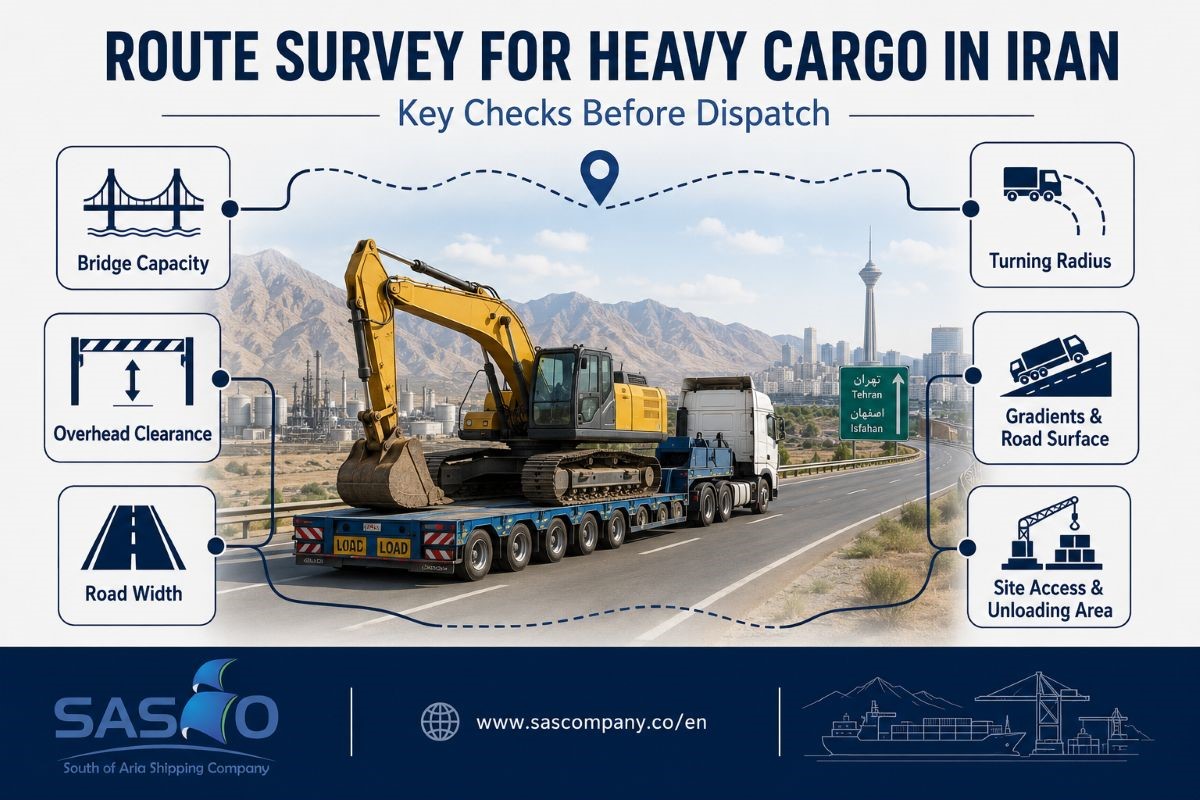
A route survey for heavy cargo in Iran determines whether the proposed vehicle-and-load combination can physically and operationally reach its destination before dispatch is authorized. It is particularly important when high loaded height, exceptional width, concentrated axle loads or limited maneuvering space could prevent the planned movement.
A technical route review may examine:
- bridge load restrictions and the suitability of the planned axle configuration;
- underpasses, tunnels and overhead clearances;
- overhead power lines, signs and other roadside obstacles;
- usable road width, shoulders and narrow sections;
- turning radius at junctions, roundabouts and urban bottlenecks;
- gradients, uneven surfaces and sections with limited ground clearance;
- access roads, gates and turning space inside the final project site;
- the proposed unloading position and the ability of the transport unit to reach it.
The survey may also identify locations where operational measures are required before the movement proceeds. These can include altered routing, traffic management, temporary obstacle coordination or changes to the transport configuration.
For abnormal load transport in Iran, permit requirements vary according to cargo dimensions, gross weight, vehicle configuration, approved route and the authorities involved. Depending on these factors, special movement permits, escort arrangements, movement-time restrictions or additional coordination may be required.
SASCO coordinates road surveys for heavy and abnormal cargo as part of heavy transport planning, together with the related inland movement, loading and unloading arrangements.
SASCO’s project experience also demonstrates why route feasibility must be established before equipment is mobilized. During the Heavy Lift Transportation from Imam Khomeini Port to Assaluyeh, three depropanizer columns weighing 67, 186 and 240 metric tons had to be transported to the project area. Because an entirely road-based movement was not feasible for the cargo dimensions and weights, the transport plan was changed to a coastal sea movement using a 3,000-ton flat barge and a roll-on/roll-off operation.
The case illustrates an important principle in heavy transport planning: route assessment is not simply about finding a road between two points. Its purpose is to determine whether the planned transport method is technically workable and, when it is not, to identify a more suitable transport solution before execution begins.
Heavy Equipment Transport from Iranian Ports to Project Sites
For imported machinery, the inland movement begins before the equipment leaves the port. Effective port-to-site transport in Iran requires the vessel or terminal operation, customs release, inland equipment availability and final delivery plan to be coordinated as connected stages rather than separate bookings.
A typical movement follows this sequence:
Vessel / terminal → discharge and port handling → customs clearance and cargo release → specialized inland transport → final route → factory, mine or project site
Bandar Abbas is an important gateway for imported machinery and industrial cargo, but the same planning approach applies to other Iranian ports depending on the shipment, vessel service and final destination.
For machinery shipping to Iran, the inland plan should ideally be prepared before the cargo is released from the terminal. Heavy equipment may arrive as breakbulk cargo, on flat-rack equipment or through a RoRo operation, and each arrival method creates different requirements for discharge, handover and trailer positioning. Delayed inland preparation can result in additional handling, storage or waiting at the port.
SASCO can connect sea freight and port logistics in Iran with the inland delivery stage, allowing port handling, cargo release and onward transport to be planned within the same logistics flow.
For heavy equipment inland transport in Iran, the final destination also matters. Delivery to a factory or established industrial zone may involve different access conditions from a remote mine or construction site. The inland leg is complete only when the equipment can reach the designated unloading point, not simply when it leaves the port.
Heavy Equipment Transport Cost in Iran
The heavy equipment transport cost in Iran is generally calculated per movement or project rather than through a simple per-kilogram freight rate. Two machines with similar weights can have significantly different transport costs if their dimensions, trailer requirements, routes or loading conditions differ.
The main pricing factors include:
|
Cost Factor |
Why It Affects the Quote |
|
Transport distance |
Longer routes increase vehicle time, fuel and operating requirements |
|
Cargo weight and dimensions |
Determine whether standard heavy transport or a more specialized configuration is required |
|
Trailer configuration |
Low-bed, additional axle lines or modular equipment have different operating costs |
|
Permit and escort requirements |
Special movements may involve additional approvals or operational coordination |
|
Route requirements |
Difficult routes can require additional planning or operational measures |
|
Loading and unloading |
Cranes, ramps or other handling arrangements may be priced separately |
|
Port and waiting time |
Terminal delays, vehicle waiting or storage can add destination-side costs |
|
Dismantling or reassembly |
Removing components to reduce the transport profile can create additional work |
|
Site accessibility |
Difficult entrances, restricted maneuvering space or remote destinations can affect equipment and operating time |
A useful quotation should therefore identify the origin, final destination, machine type, transport dimensions, gross weight, loading and unloading method, and requested movement date. Photographs and technical drawings can also be important for non-standard machinery.
Unless specifically included in the quotation, port charges, customs duties and taxes, storage, crane services, insurance, dismantling and other third-party costs should not be assumed to form part of the inland transport rate.
For a project-specific rate, request a heavy equipment transport quote from SASCO.
Customs and Documentation for Heavy Equipment
Imported heavy machinery must complete the applicable customs procedure before inland delivery can begin. Required documents vary by equipment type, origin, import regime and regulatory requirements, but may include the commercial invoice, packing list, transport document, certificate of origin and cargo-specific permits.
For non-standard machinery, declared dimensions, weight and technical specifications should remain consistent across shipping and customs documents. Accurate documentation can also help avoid discrepancies when arranging customs clearance in Iran.
Risks, Lashing and Insurance
Heavy machinery is exposed to specific risks during loading, road movement and unloading. Poor weight distribution, unsuitable securing points, cargo movement on the trailer, clearance issues or handling errors can damage the machine or transport equipment.
Lashing and securing should reflect the machine’s weight, center of gravity, approved securing points and transport conditions. Insurance should likewise be selected according to cargo value, route and handling exposure.
Why Choose SASCO for Heavy Equipment Transport in Iran?
SASCO coordinates the key stages of heavy equipment transport in Iran, including port handling, customs support, inland movement, route assessment, permit coordination, loading and unloading, and final-site delivery.
This capability is supported by practical experience with heavy and oversized cargo. Our experience includes the Heavy Lift Transportation from Imam Khomeini Port to Assaluyeh and other heavy and oversized cargo movements across Iran.
For project-specific pricing, request a heavy equipment transport quote.
Frequently Asked Questions
What information is needed for a heavy equipment transport quote?
Origin, destination, equipment type, transport dimensions, gross weight, loading and unloading conditions, and the required movement date are the main inputs.
Can excavators and construction machinery be transported across Iran?
Yes. The appropriate transport method depends on the machine’s dimensions, weight, route and site-access conditions.
Does oversized heavy equipment require special permits in Iran?
It may. Permit, escort and movement requirements depend on cargo dimensions, weight, vehicle configuration, approved route and applicable authority requirements.
Can imported machinery be delivered from an Iranian port to a project site?
Yes. Port release, inland transport and final-site delivery can be coordinated as one port-to-site movement.
Is cargo insurance automatically included?
Not necessarily. Insurance requirements and coverage should be confirmed separately according to shipment terms and cargo value.
How is heavy equipment transport priced?
Pricing is normally project-specific and depends on the route, cargo profile, transport equipment, permits, handling requirements and destination conditions.