

Why Route Dependency Is a Strategic Risk in Iran Logistics
Route dependency becomes a serious risk when too much cargo relies on one port, transshipment hub, border crossing, rail corridor, or transit country. In stable conditions, this may seem efficient, but during congestion, customs delays, tariff changes, documentation problems, insurance limitations, or capacity shortages, the same route can quickly become a bottleneck.
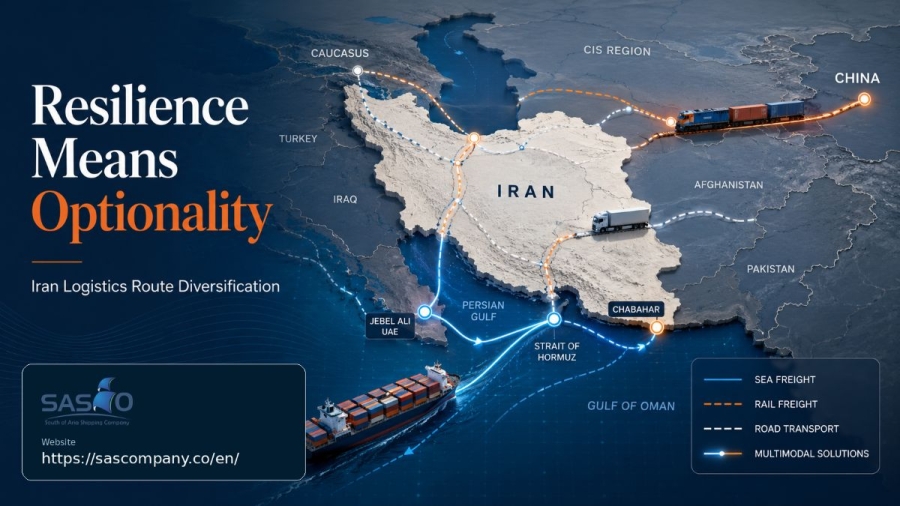
For Iran-linked trade, resilience means keeping several commercially tested sea, rail, road, and multimodal freight options available before disruption affects cost, timing, or customs planning.
Why Jebel Ali Became Important for Iran-Linked Trade
Jebel Ali became important for Iran-linked trade because it offered more than simple port access. It developed into a regional logistics platform with connections to international shipping lines, transshipment services, warehousing, consolidation, container handling, re-export facilities, and feeder options. Its scale explains why it became so attractive. DP World describes Jebel Ali as the world’s largest man-made harbour, with more than 80 weekly services connecting over 150 ports globally.
For many importers, exporters, and traders, this created operational convenience. Cargo from different origins could move through one established hub, be stored or consolidated, and then be redirected toward Iran or nearby markets. For some shipments, Jebel Ali also provided flexibility in documentation, cross-stuffing, cargo handling, and regional distribution.
However, convenience should not be confused with resilience. Jebel Ali can remain a useful part of Iran-linked trade, but relying on it too heavily exposes businesses to route dependency. The same logic applies to any single alternative, including a northern rail corridor, a Caucasus route, a CIS connection, or even the China–Iran rail freight route if it is used without backup options.
The goal is not to abandon Jebel Ali. The goal is to build a wider logistics portfolio where sea freight, rail freight, road transport, southern Iranian ports, Gulf of Oman access, Eurasian corridors, and multimodal transport solutions can be compared based on shipment needs.
Practical Alternative Routes Beyond Jebel Ali
The best alternatives to Jebel Ali are not the same for every shipment. A practical Iran logistics route diversification strategy should compare several routes based on cargo type, origin, destination, urgency, customs requirements, and risk exposure.
For direct Iran-bound cargo, southern Iranian ports can reduce reliance on regional transshipment hubs and provide more direct market access. For shipments exposed to Persian Gulf or Strait of Hormuz risk, Gulf of Oman access and Chabahar-related options can support a wider maritime strategy, especially when cargo owners need alternatives outside the most congested Gulf routes.
Chabahar is also gaining operational relevance. According to India’s Ministry of External Affairs, India Ports Global Limited signed a ten-year contract with Iran’s Ports and Maritime Organisation on 13 May 2024 to equip and operate the Shahid Beheshti Terminal of Chabahar Port. Since 2018, the port has handled more than 450 vessels, 134,082 TEUs of containerized cargo, and over 8.7 million tons of bulk and general cargo.
For cargo connected to Eurasia, Central Asia, the Caucasus, or CIS markets, land and multimodal corridors can also play an important role. Rail-road and sea-rail-road combinations may be useful for industrial cargo, machinery, project cargo, and containerized shipments where timing, predictability, and backup routing matter more than the lowest single freight rate.
In practice, the strongest alternative is not one route that replaces Jebel Ali. It is a portfolio of usable options: direct Iranian ports for suitable cargo, Gulf of Oman access for maritime flexibility, Oman or Pakistan routes for selected regional movements, China–Iran rail for specific containerized flows, and Caucasus/CIS corridors for northern and regional trade. The goal is to keep these options tested before disruption happens.
A Logistics Corridor Is More Than a Line on the Map
A logistics corridor is not simply a route connecting two points. It is a commercial, regulatory, operational, and political system. A corridor may look available in theory, but its real performance depends on transit tariffs, rail capacity, wagon availability, border efficiency, customs rules, documentation requirements, seasonal restrictions, and the priorities of transit countries.
This is why corridor planning must go beyond distance and freight rates.
- A short route may become expensive if border delays increase storage costs.
- A rail route may become less competitive if wagon availability is limited.
- A transit corridor may become unpredictable if customs procedures change or tariff policies are revised with little notice.
Even when political relations are positive, commercial conditions may still change because of domestic costs, infrastructure pressure, market demand, or national transit priorities.
For importers, exporters, industrial companies, and traders, these risks affect landed cost, delivery time, production planning, and customer commitments.
Iran logistics route diversification should therefore include operational testing, cost comparison, customs readiness, and backup planning. A corridor is only useful when it is commercially usable, document-ready, and reliable enough for the specific cargo being moved.
Comparing Key Route Options
A resilient freight strategy does not choose sea against land or south against north. It keeps several options active and matches the route to the shipment.
|
Route Option |
Best Used For |
|
Jebel Ali |
Transshipment, re-export, consolidation |
|
Southern Iranian ports |
Direct Iran import/export |
|
Gulf of Oman access |
Alternative maritime access |
|
Oman and Pakistan options |
Regional maritime alternatives |
|
China–Iran rail route |
Containers, machinery, industrial parts |
|
Caucasus and CIS corridors |
Regional trade and northern markets |
|
Multimodal sea-rail-road |
Flexible shipments |
Sea Routes vs. Land Corridors
Sea routes and land corridors both matter in Iran logistics, but they create different types of flexibility. Maritime logistics often provides optionality because cargo can shift between ports, transshipment hubs, feeder services, and regional gateways. Companies may compare Jebel Ali, southern Iranian ports, Gulf of Oman access, Oman, Pakistan, and other maritime options depending on cargo conditions.
But sea freight is not risk-free. It can be affected by port congestion, freight volatility, sanctions pressure, insurance limitations, vessel schedule changes, and maritime chokepoint risks.
Land corridors offer a different value. Rail freight and road transport can support faster regional movement, access to CIS markets, Caucasus routes, Central Asia, and the China–Iran rail route. But land-based corridors depend on specific countries, border crossings, rail networks, trucking capacity, customs systems, and transit policies.
A strong Iran logistics route diversification strategy keeps several routes tested and commercially realistic, so each shipment can move through the route that best fits its cargo profile, timeline, cost structure, and risk level.
How Importers and Exporters Should Choose the Right Route
Choosing the right route should not be based only on the lowest freight rate. A cheaper route may become expensive if it creates storage charges, demurrage, customs problems, border delays, or unreliable delivery times.
|
Decision Factor |
What to Check |
|
Cargo type |
Bulk, containerized, sensitive, perishable, industrial, machinery, raw materials |
|
Urgency |
Standard shipment, time-sensitive cargo, emergency delivery, production deadline |
|
Cost structure |
Freight rate, transit tariff, storage, demurrage, insurance, delay costs |
|
Corridor risk |
Border reliability, policy changes, transit country rules, rail or trucking capacity |
|
Documentation |
Customs documents, certificates, transit paperwork, consignee details |
|
Flexibility |
Can cargo shift from sea to rail, rail to road, or road to sea? |
|
Final destination |
Iran, CIS markets, Caucasus, Turkey, Iraq, Afghanistan, Central Asia |
How SASCO Helps with Route Planning and Freight Decisions
SASCO supports importers, exporters, traders, and industrial companies by treating route planning as a practical risk-management decision, not only a freight-rate comparison. In today’s Iran logistics environment, the right route depends on cargo type, urgency, documentation, customs requirements, cost structure, border reliability, and available alternatives.
Through its freight forwarding and multimodal transport experience, SASCO can help compare options such as sea freight, rail freight, road transport, southern Iranian ports, Jebel Ali, Gulf of Oman access, the China–Iran rail route, Caucasus connections, CIS routes, and other regional corridors. This helps companies understand not only which route may be cheaper, but which route is more suitable, reliable, and flexible for a specific shipment.
SASCO can also support cargo review, document readiness, carrier coordination, local partner communication, customs-related planning, and practical multimodal freight solutions based on cost, timing, and risk. For companies evaluating Iran logistics route diversification, this type of route comparison can reduce uncertainty before cargo moves.
To discuss available freight options, visit SASCO’s freight forwarding services or contact SASCO page.
Conclusion: Resilience Means Optionality, Not Route Replacement
The real debate is not Jebel Ali versus Eurasia, or south versus north. The real issue is dependency versus optionality. Moving away from one logistics hub can be useful, but only if it creates a more flexible and diversified supply chain.
A stronger Iran logistics strategy should keep several routes active, tested, and commercially usable. Jebel Ali, southern ports, Gulf of Oman access, northern corridors, Caucasus routes, CIS connections, rail freight, road transport, and multimodal sea-rail-road solutions can all play different roles.
In modern trade, resilience does not come from one perfect route. It comes from having practical alternatives before disruption happens.
FAQ
What is Iran logistics route diversification?
It means using several tested sea, rail, road, and multimodal freight options instead of depending on one hub, corridor, border crossing, or transit country.
Is Jebel Ali still useful for Iran-linked trade?
Yes. Jebel Ali can still be useful for transshipment, warehousing, consolidation, and re-export. The risk is not using Jebel Ali; the risk is relying on it too heavily without backup options.
Is the China–Iran rail route a replacement for sea freight?
Not completely. It can be valuable for containerized goods, machinery, industrial parts, and time-sensitive shipments, but it still depends on border efficiency, wagon availability, tariffs, and customs coordination.
How should companies choose between sea, rail, and road freight?
They should compare cargo type, urgency, total cost, documentation, border reliability, corridor risk, and final destination. The right route should match the shipment, not force every shipment into the same corridor.
What are the best alternatives to Jebel Ali for Iran cargo?
The best alternatives to Jebel Ali for Iran cargo are direct southern Iranian ports, Gulf of Oman access through Chabahar-related routes, China–Iran rail options, Caucasus/CIS corridors, and multimodal sea-rail-road solutions, depending on cargo type, urgency, destination, and risk level.